Detecting a cavity beneath a road without digging. Measuring brain activity without routinely enclosing the patient in a cryogenic machine. Helping a vehicle find its way when GPS goes silent. These promises belong to the world of quantum sensors, less spectacular than that of quantum computers, but often closer to practical use. Looking ahead to September 2026, their appeal is simple: there is no need to wait for a universal quantum machine to harness atoms. But established demonstrations must still be distinguished from hoped-for commercial applications.
Quantum technology measures before it computes
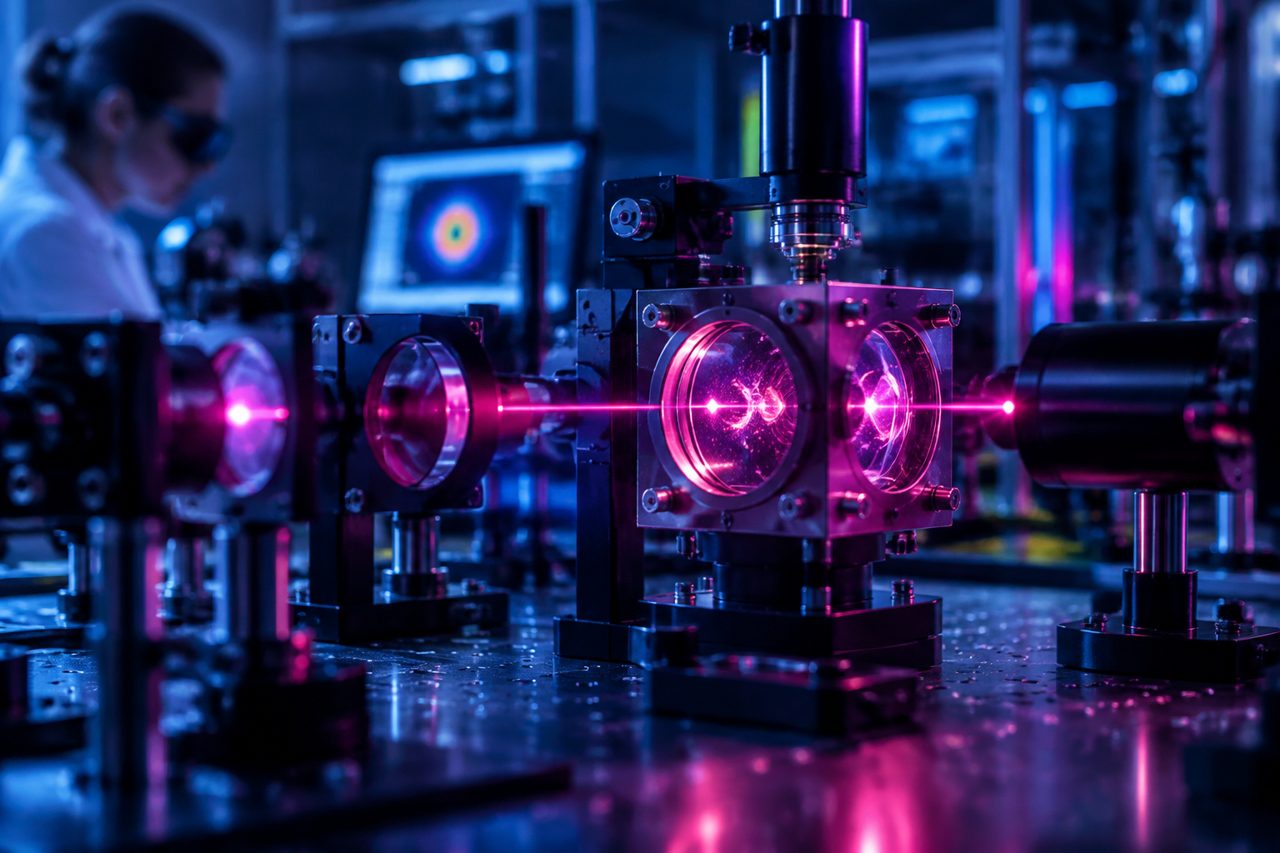
A quantum sensor turns a microscopic property into a measurement tool. Depending on its design, it exploits an atom’s energy levels, its spin or the wave-like nature of matter. An external disturbance—gravity, a magnetic field or motion—changes that state. Lasers, microwaves and readout electronics then extract information from it.
Unlike a universal quantum computer, it does not need to orchestrate a vast array of error-corrected qubits. Its main task is to isolate a useful signal and control disturbances. Nor is the field entirely new: atomic clocks are established technologies. What is new is miniaturization, new architectures and the transfer of sophisticated instruments into less hospitable environments.
Gravimeters: reading the subsurface without seeing it
Earth’s gravity varies slightly with the distribution of mass. A cavity, a dense rock layer or a water reservoir can produce different signatures. In an atomic gravimeter, laser-cooled atoms serve as a reference: their fall is probed by pulses of light, and the resulting interference provides information about gravitational acceleration.
Quantum gravimeters are already commercially available, notably from the French company Exail, which inherited Muquans’ expertise in this field. And in 2022, a University of Birmingham team published a demonstration in Nature of tunnel detection outdoors using a quantum gradiometer. This instrument measures a difference in gravity between two positions, helping to reject certain disturbances common to both.
For infrastructure managers, the stakes are practical: better targeting ground investigations before construction, searching for dangerous voids or monitoring subsurface changes. In exploration, these measurements could complement seismic and electrical methods and drilling. A gravimeter does not, however, produce an underground photograph: several geological configurations can explain the same signal. Interpretation therefore requires models and additional data.
The challenge is no longer simply to improve sensitivity. It is to measure quickly, despite vibrations, on uneven ground and with a small team. An outstanding instrument that requires a lengthy setup can lose its economic advantage. For September 2026 and beyond, the credible prospect is specialized applications, not wholesale replacement of geophysical surveys.
Magnetometers: listening to the tiny signals of living systems
The heart and brain produce extremely weak magnetic fields. Measuring them interests physicians because it provides information about the electrical activity of tissue. Magnetoencephalography has been around for a long time, but conventional systems often use superconducting detectors known as SQUIDs, together with cryogenics and expensive facilities.
Optically pumped magnetometers, or OPMs, offer another path. They use the response of atoms, generally in a vapor, to a magnetic field. They do not require the cryogenic cooling used by SQUIDs, although some cells must be heated. Research has already shown that these sensors can be placed close to the skull in wearable devices better suited to different head shapes and sizes.
The potential appeal is particularly strong for children or people who struggle to remain still. But “wearable” does not mean “usable anywhere.” Earth’s magnetic field, an elevator or a nearby vehicle can overwhelm the target signal. Magnetic shielding, active compensation, calibration and data processing remain crucial. And an impressive experimental measurement is not enough to establish a clinical benefit.
Another promising family consists of sensors based on defects in diamond, notably nitrogen-vacancy centers. Their spin can act as a magnetic probe at a very small scale. They are of interest for materials analysis and biological research. Their versatility must not, however, obscure a basic reality: sensitivity, spatial resolution, accessible depth and operating conditions always involve trade-offs.
Navigating when satellites no longer respond
Jamming, spoofing, tunnels, underwater navigation: satellite signals are neither available nor reliable everywhere. Quantum sensors are therefore attracting considerable interest for autonomous navigation. Atomic accelerometers and gyroscopes could improve inertial navigation systems, which estimate displacement from measured motion.
The classic problem is the accumulation of errors: a small bias eventually produces a large position error. Atomic references could reduce certain types of drift. Another approach involves comparing magnetic or gravitational measurements with existing maps. But map quality, ambiguities in geophysical features and disturbances from the vehicle limit this method.
The most plausible path is hybrid: fast, robust conventional sensors, a quantum reference to correct certain biases, and software-based fusion with other information. Demonstrations aboard vehicles are important milestones, not proof that a universal quantum navigator is ready. Size, power requirements and vibration resistance remain decisive criteria.
Clocks: precision becomes infrastructure
Atomic clocks already underpin satellite navigation systems and the distribution of time references. Optical clocks, which probe higher-frequency transitions, are pushing metrological performance further. They are of particular interest to laboratories preparing for a future redefinition of the second.
Their value goes beyond telling the exact time. According to general relativity, two clocks at different gravitational potentials do not tick at the same rate. Comparing highly precise clocks thus opens up the prospect of a new form of geodesy. In practice, comparison links and error control matter as much as the clock itself. Transportable versions remain far more demanding than a pocket-sized instrument.
The real test: performing better in the field
The market will not be won on sensitivity records alone. A benefit will have to be demonstrated across an entire task: fewer unnecessary boreholes, more accessible medical measurements or more resilient navigation. Cost, maintenance, training and reproducibility will carry considerable weight. The term “quantum” guarantees neither consistent superiority nor profitability; each instrument will have to outperform an existing solution for a specific need.
What next? The most credible outlook for the coming years is gradual adoption: specialized instruments, measurement services, then integration into hybrid systems. Quantum sensors could transform some professions before a large-scale quantum computer arrives. Their success will be marked less by a spectacular announcement than by the quiet moment when a geophysicist, navigator or clinician can no longer do without them.