In October 2015, a Google computer program named AlphaGo defeated Fan Hui, the two-time European Go champion, by 5 victories to 0. This was the first time in history that a computer beat a professional on a full 19×19 Go board. This event was not made public until January 2016. AlphaGo further drove the point home by beating Lee Sedol, world champion and the best Go player in the world for a decade, by 4 victories to 1, from March 8 to 15, 2016.
This event opened a new era for artificial intelligence, offering possibilities that were not even imaginable a few months ago.
We still remember IBM’s Deep Blue computer beating world chess champion Garry Kasparov in May 1997. So, what makes this year’s event so extraordinary?
From Chess to Go, a change of scale
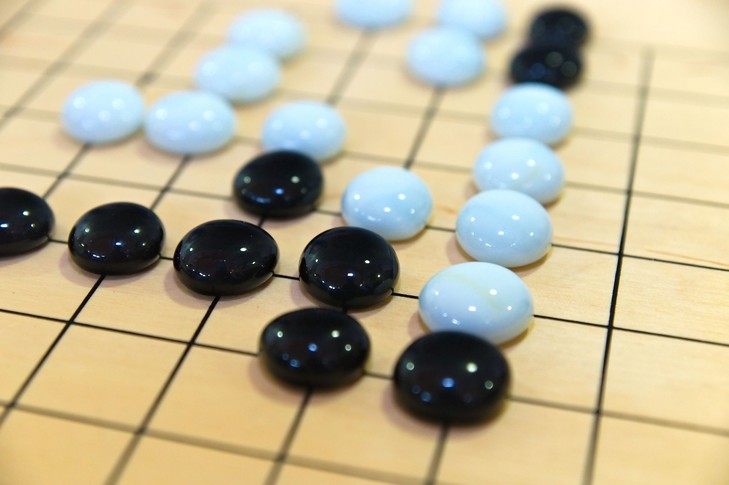 Go, a Chinese game over 2500 years old, is based on intuition, creativity, and strategy. It is theoretically impossible to analyze with a computer. And for good reason: the number of possible combinations quickly exceeds the Googol (10100).
On a chessboard, there are 20 possible moves for the first turn. If we consider the first 2 rounds (each player plays 2 moves), there are 20,000 possible combinations.
On a Go board, there are 361 possible positions for a piece. Once the piece is played, the opponent has 360 game possibilities. You then have 359 possibilities for the next piece. Over a 2-round game, there are nearly 2 x 10¹⁰ possibilities.
It is easy to understand that Go is already 106 times more complex than chess after 2 rounds. 10 rounds of Go present 1051 possibilities, knowing that our galaxy is composed of 1068 atoms!!!!! By making assumptions about the opponent’s common sense, these possibilities can be reduced (what is called alpha-beta pruning). It is nevertheless absolutely unthinkable to explore all possibilities, even by the most powerful computer.
To this, we must add the extreme difficulty in Go of constructing an evaluation function, which allows comparing 2 situations to choose the best one. This is why no machine had ever beaten a professional Go player.
Behind AlphaGo, DeepMind
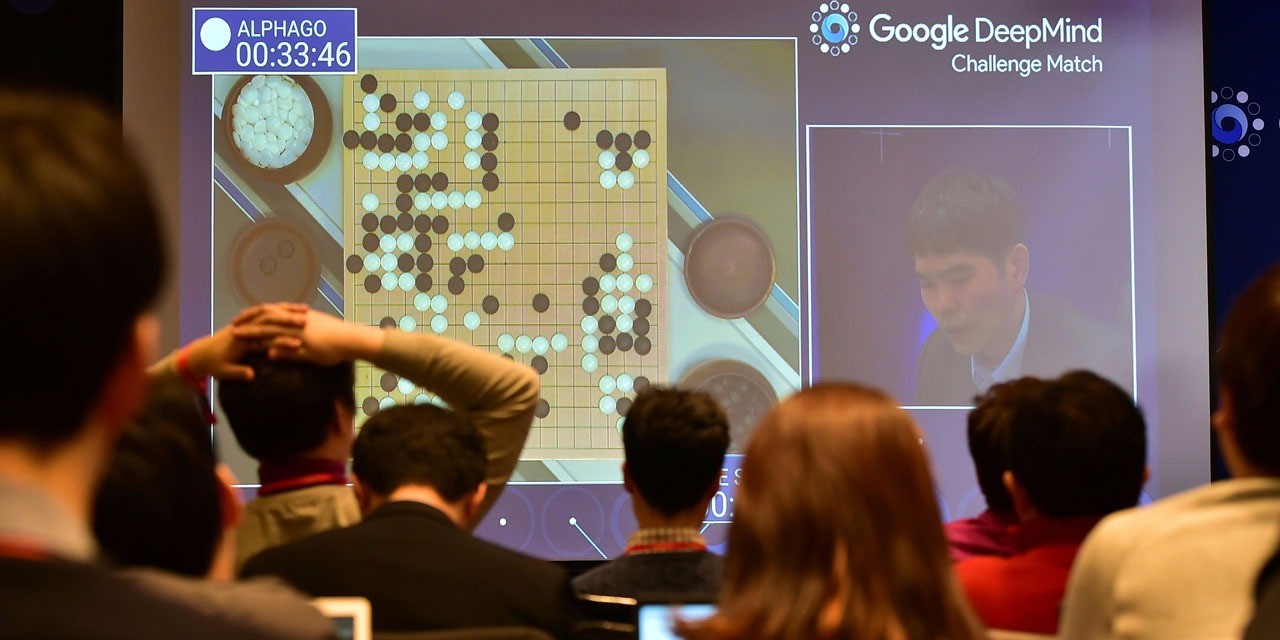 AlphaGo comes from the research of a British start-up: DeepMind Technologies. Created in 2010, DeepMind Technologies was founded by 3 people, including 2 researchers in artificial intelligence: Demis Hassabis, Shane Legg, and Mustafa Suleyman.
DeepMind Technologies was acquired by Google in January 2014 for $400 million. This is the Mountain View firm’s largest European acquisition.
Behind DeepMind, deep learning
 DeepMind Technologies exploits a booming science called deep learning.
In 1957, the perceptron appeared, a simplified mathematical model of the biological neuron. Towards the end of the 1980s, layered artificial neural networks appeared.
Yann LeCun, one of the inventors of deep learning and current director of the Facebook Artificial Intelligence Research laboratory, defended his thesis in 1987. He developed a program used to read nearly 20% of checks issued in the USA.
But as computer power at the time was not sufficient to allow comfortable use of the method, it was gradually abandoned in favor of other approaches. it was revived around 2000 with a meteoric advance.
Behind deep learning, neural networks
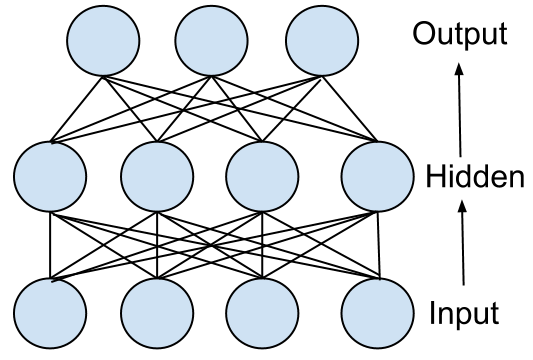 The study of artificial neural networks (ANN) aims to develop machines capable of learning. Learning can be of two types: supervised or unsupervised. In the first case, the machine has no prior knowledge of the rules related to the learned field. It visualizes millions of previously recorded games. In the second approach, the machine plays millions of games against itself to find its own strategies.
AlphaGo uses a combination of these two approaches, supported by two multi-layer neural networks that it programs successively. Just like a child observing his grandfather playing poker, he learns on the fly the value of cards, the rules of the game, and strategy throughout the games. He then retreats to play alone in his corner, to find his own techniques and refine his strategy.
In the last 5 years, deep learning has advanced considerably on a theoretical level. The development of new algorithms for multi-layer neural networks has led to lightning advances in different fields of application such as vision, speech recognition, biology, DNA analysis, or games.
In this last field, deep learning has allowed the creation of machines capable of analyzing millions of games and creating their own strategies.
Lee Sedol says the reason for his defeat is that the machine uses completely unusual strategies that no human would have ever used. He claims that over time, he will be able to adapt to this kind of behavior and eventually beat the machine. But let’s bet that, like the river that looked itself in Narcissus’s eyes while he admired his own reflection on the water’s surface, the machine will be able to adapt its own strategy as the world champion gets used to its behaviors: the intelligence race between man and machine for supremacy and domination on planet earth has therefore already begun.
Deep learning and the invasion of robots
 The field of autonomous and self-learning machines already engenders fear fueled by science fiction movies: for the first time in human history, a machine possesses more intelligence than the most efficient living human.
Even if it concerns -for now- very specific fields, some people like the billionaire entrepreneur Elon Musk or the physicist Stephen Hawking warn that one day soon, these machines could take control of their destiny and become uncontrollable for Mankind.