




Artificial intelligence is moving faster than most companies can absorb. The latest AI news is no longer just about chatbots becoming more fluent or image generators becoming more realistic. The industry is now entering a more serious phase: AI is becoming infrastructure, enterprise software, regulation, cybersecurity, healthcare, investment strategy and geopolitical power.
Here are ten AI developments that show where the market is heading.
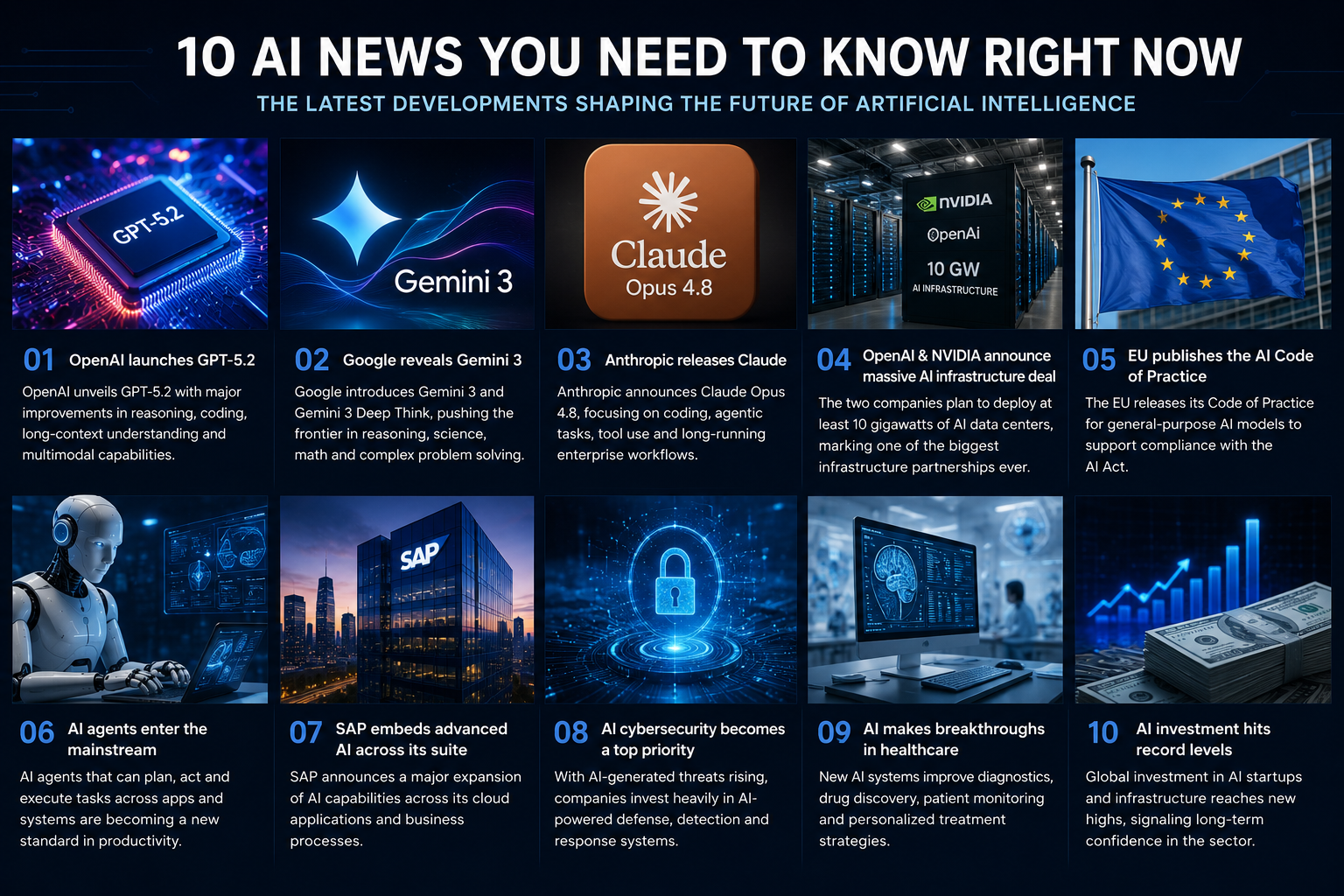
1. OpenAI pushes AI deeper into professional work
OpenAI’s GPT-5.2 marks a shift from consumer experimentation to professional execution. The model is positioned around reasoning, long-context understanding, coding, vision and agentic workflows. That matters because companies are no longer asking whether AI can write a paragraph. They are asking whether it can help produce reports, analyze documents, write software, build presentations, manage workflows and support complex knowledge work.
The real message is simple: AI is becoming a productivity layer inside the modern workplace.
2. Google strengthens Gemini’s reasoning strategy
Google’s Gemini 3 Deep Think shows how important reasoning has become in the AI race. The focus is not only on speed, but on the ability to solve harder problems in science, logic and mathematics. This is significant because the next frontier is not just conversational AI. It is AI that can support research, engineering, technical planning and high-value decision-making.
For Google, Gemini is also more than a model. It can become an AI layer across search, cloud, Workspace, Android and developer tools. That distribution advantage could be one of Google’s strongest weapons.
3. Anthropic upgrades Claude for agents and coding
Claude Opus 4.8 reinforces Anthropic’s position in professional AI. The company presents the model as stronger for coding, agentic tasks, computer use and long-running work. This is important because enterprises increasingly want AI systems that can do more than answer questions. They want systems that can operate across tools, support developers, inspect code, execute tasks and remain reliable over time.
Claude’s positioning around honesty and uncertainty is also strategically important. In business environments, a model that admits what it does not know may be more valuable than one that gives confident but unreliable answers.
4. OpenAI and NVIDIA show that AI is now an infrastructure race
One of the biggest AI stories is the OpenAI-NVIDIA partnership to deploy massive AI data center capacity. The plan shows that the AI race is no longer only about models. It is about GPUs, energy, data centers, cooling systems, cloud architecture and capital expenditure.
This changes the economics of the sector. The companies that control compute will have a major advantage. AI is becoming less like a simple software business and more like an industrial infrastructure business.
5. Europe turns AI regulation into a market reality
The European Union’s General-Purpose AI Code of Practice is another key development. It helps providers comply with AI Act obligations around safety, transparency and copyright. This matters because regulation is now becoming part of AI product strategy.
For European companies, compliance may first look like a constraint. But it can also become an advantage. In sectors such as finance, healthcare, public services and enterprise software, trust is not optional. Responsible AI may become a commercial differentiator.
6. AI agents enter the mainstream
AI agents are becoming one of the most important trends in the market. The difference between a chatbot and an agent is simple: a chatbot answers, while an agent can plan, use tools and execute tasks. This could transform software, customer service, coding, operations, HR, finance and sales.
But agents also create new risks. If an AI system can act across applications, who is responsible when it makes a mistake? What happens when it accesses the wrong data, sends the wrong message, changes the wrong file or triggers the wrong workflow? The agent era will require governance, audit trails and human oversight.
7. Enterprise software companies move aggressively into AI
SAP’s 2026 announcements around the Autonomous Enterprise, Joule Work, SAP Business AI Platform and SAP Autonomous Suite show that AI is entering the core of enterprise software. This is a major signal. AI is no longer only a startup playground. It is being embedded into the tools that run finance, logistics, procurement, HR and operations.
For businesses, this means AI adoption may not happen through one spectacular tool. It may happen quietly, inside the software they already use every day.
8. AI cybersecurity becomes a top priority
As AI becomes more powerful, cybersecurity becomes more urgent. Companies must defend against AI-generated phishing, automated attacks, deepfake fraud, model abuse and data leakage. At the same time, AI is also becoming a defensive tool, helping security teams detect anomalies, analyze threats and respond faster.
This creates a dual-use problem. The same technology that helps defenders can also help attackers. That is why AI security will become one of the most sensitive areas of the industry.
9. Healthcare AI moves from promise to practical use
AI in healthcare is becoming more concrete. The strongest opportunities are in diagnostics support, medical imaging, patient monitoring, drug discovery, administrative automation and personalized treatment pathways. The potential is huge, but the sector requires caution. Healthcare AI must be accurate, explainable, secure and clinically validated.
The opportunity is not to replace doctors. The opportunity is to reduce administrative burden, support decision-making and improve access to care.
10. AI investment is still breaking records
The financial side of AI remains spectacular. Venture funding data shows that AI continues to attract massive capital, especially around frontier labs, infrastructure, agents, chips, robotics and computational biology. Investors are betting that AI will not be a short-term trend, but the next foundational layer of the economy.
There is still a risk of a bubble. Some valuations are extremely high, and many AI startups still need to prove durable revenue. But the direction is clear: capital is concentrating around companies that can control infrastructure, distribution, data or enterprise workflows.
The bigger picture
Taken together, these ten stories show the same trend. The AI race has moved beyond the chatbot era. It is now a race for execution, infrastructure, regulation and control.
The winners will not simply be the companies with the most impressive demos. They will be the companies that can build reliable systems, access enough compute, integrate into real workflows, satisfy regulators and deliver measurable value.
For Europe, the challenge is especially clear. Europe has strong researchers, startups, engineers and regulators. But it still needs more infrastructure, more capital and more companies capable of scaling globally. Responsible AI is important, but sovereignty requires more than rules. It requires compute, talent, industrial partnerships and speed.
The latest AI news is therefore not just about technology. It is about who will control the next layer of the digital economy.


