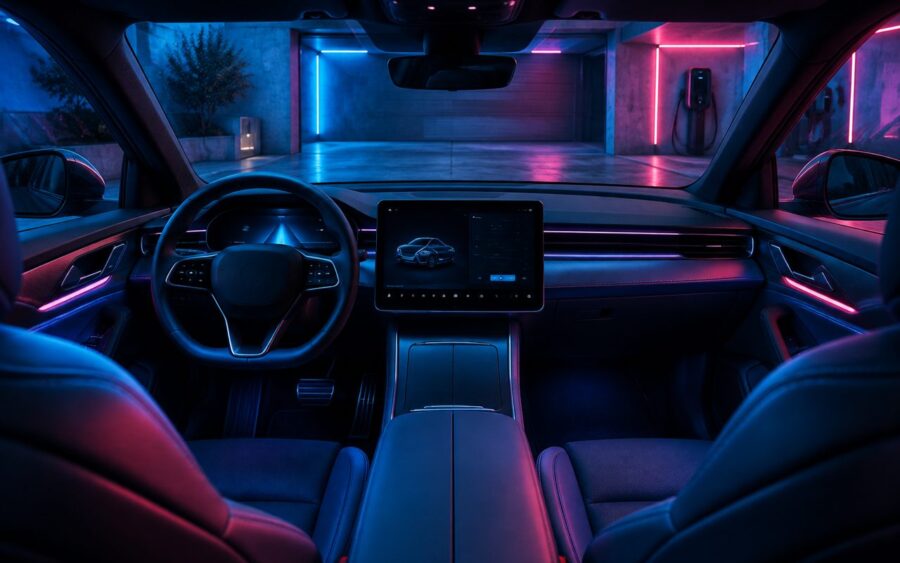
You bought the car, its heated seats and its driving assistant. But did you buy the right to use them for the vehicle’s entire lifetime? With software-defined cars, the answer is no longer found solely on the invoice. It also depends on a user account, a licence and sometimes a remote server. Looking ahead to September 2026, changes already under way point to a new balance of power: drivers own the machine, while manufacturers may retain control over some of its capabilities.
A car that keeps changing after delivery
The principle behind the software-defined vehicle is simple: an increasing share of its functions depends on programs that can be modified rather than fixed equipment. Software already controlled the engine and braking. What is new is its integration into an architecture that allows more behaviours and services to be modified remotely.
Tesla popularised over-the-air updates capable of improving an interface or changing certain aspects of performance. Established carmakers have followed, with capabilities varying by model. An update can fix a fault without a workshop visit, enhance the charging planner or improve energy management. It can also move a control, change a well-liked interface or add a condition of use.
This flexibility is a genuine advance, but it shifts the decision-making power. A conventional car aged primarily through wear and tear. A connected vehicle can also lose a feature because a service shuts down, a contract expires or infrastructure becomes obsolete. Product quality therefore also depends on decisions made after the sale.
Three very different purchases behind the same button
The word “option” now conceals several different realities. To understand what you are paying for, you need to distinguish between the physical equipment, its software activation and the service that accompanies it.
- Installed equipment: a camera, a heating element or a control unit is physically part of the vehicle.
- Software unlocking: a payment authorises the use of a capability already present, sometimes for an indefinite period.
- Connected services: enhanced navigation, traffic data and remote control rely on a service that may be billed periodically.
These categories can overlap. A driver-assistance feature uses onboard hardware, software and sometimes updated data. Yet paying outright for an activation is not the same as subscribing to a monthly service. And “subscription-free” does not necessarily mean “transferable to the next owner” or “guaranteed for the vehicle’s entire lifetime”.
Heated seats: a symbol of commercial limits
BMW experienced this first-hand. After offering subscriptions in certain markets to activate heated seats that were already installed, the carmaker announced in 2023 that it would abandon this approach for the future vehicles concerned. Customers’ reluctance was understandable: why pay repeatedly to use a heating element beneath your own seat?
This episode did not spell the end of digital options. Mercedes-Benz, for example, has marketed paid upgrades in the United States that increase the performance of certain electric models. The economics remain attractive: produce more standardised vehicles, then differentiate their capabilities through software. For customers, there is value if a feature can be tried out or activated temporarily. That value disappears if the offer turns an expected piece of equipment into a permanent toll.
Who owns the feature? The contract must provide the answer
In practice, there is no single form of ownership that covers the car, all its software and its associated services indiscriminately. The buyer becomes the owner of the vehicle. They generally receive a right to use the onboard software without acquiring its intellectual property. Their rights to a particular feature then depend on the offer, the contract and the applicable mandatory rules.
This distinction does not give manufacturers free rein to withdraw everything. In France and the European Union, the conformity of the goods, promised characteristics and pre-contractual information matter. The framework for goods with digital elements includes obligations concerning the updates needed to maintain conformity. A contractual clause does not automatically override consumer protections.
Conversely, these protections do not amount to a blanket promise of everlasting connected services. The expected support period, the nature of the service and the commercial commitments must be examined. A shutdown announced long after purchase is not assessed in the same way as the immediate disappearance of a feature explicitly sold to the customer. In a dispute, advertising and the order form can become just as important as the terms and conditions.
The used-car market exposes the ambiguities
Imagine a listing: “fully loaded, advanced assisted driving, connected navigation”. During the test drive, everything works. After the sale, the change of ownership reveals that a subscription belonged to the seller, a trial period is expiring or an activation cannot be transferred. The vehicle has not changed physically; its usable equipment has.
Transfer policies vary by brand and offer. At Tesla, for example, opportunities to move certain software capabilities to another vehicle have been offered through promotional campaigns subject to conditions. This is a reminder that a feature may be tied to the vehicle, the account or a particular offer. The specific case needs to be checked, rather than inferring a rule from another model.
The used-car market would therefore benefit from separating three categories in every listing: installed hardware, features permanently activated under the terms of sale, and temporary services. A screenshot is not enough. Buyers should request written confirmation of the duration and transferability, then check the procedure for changing accounts and erasing personal data.
The real battle: how long support lasts
The issue goes beyond the price of options. Who will maintain digital features once the vehicle has changed hands several times? What will remain usable without a connection? And will an independent repairer be able to replace and then re-pair a component without relying exclusively on the manufacturer’s network?
The European Data Act, which is scheduled to apply generally from 12 September 2025, aims, among other things, to facilitate access to data generated by connected products and its sharing with third parties. This framework may encourage competing services, but it does not create a universal right to unlock options free of charge. Data access, repairs and software licensing remain separate issues.
What next? For September 2026 and beyond, the desirable scenario is not a car deprived of updates, but one whose digital rights are clear before purchase. Minimum support periods, offline functionality and resale rules could become criteria as decisive as driving range. A manufacturer that clearly guarantees what owners will retain will have a lasting selling point: offering a car that can evolve without making its owner feel they are renting it all over again.