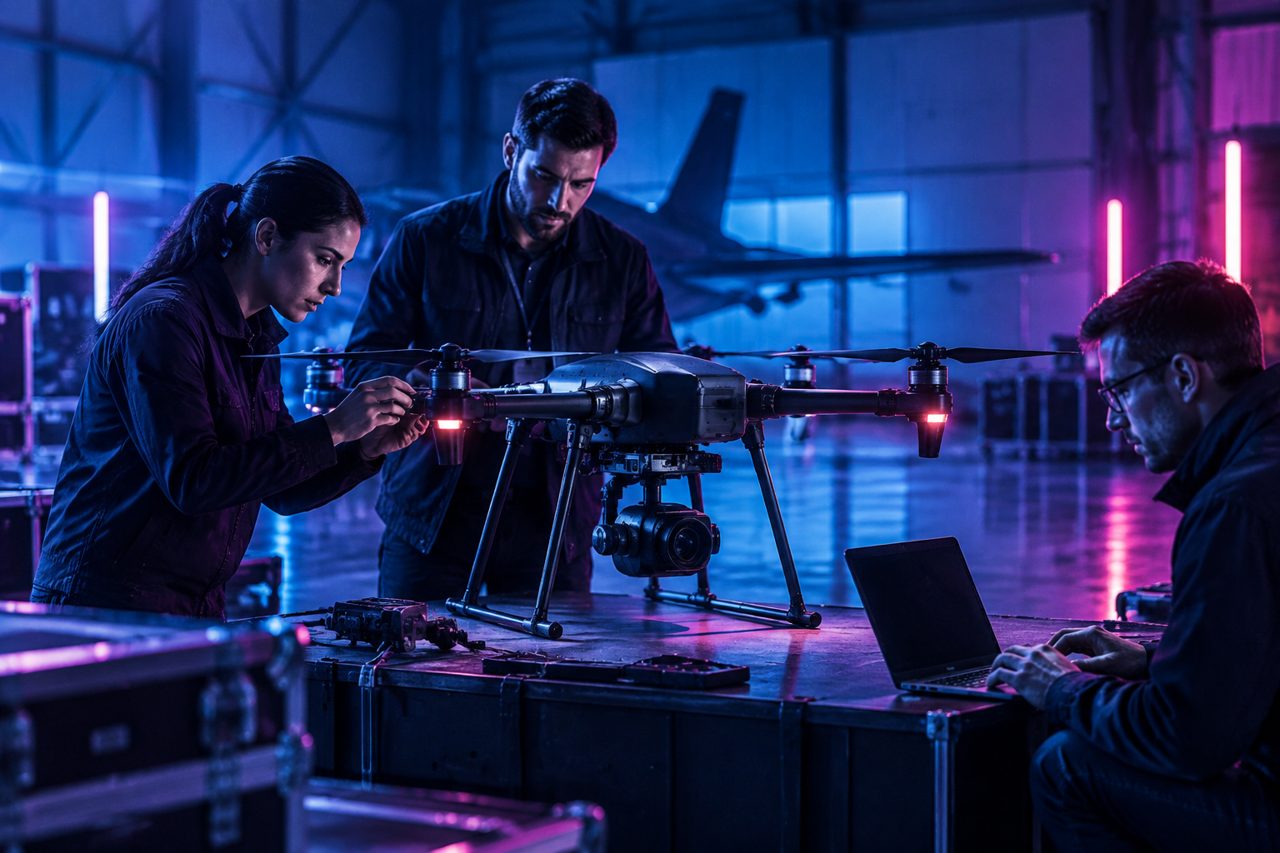
The same drone can inspect a power line or scout terrain. The same sensor can detect an industrial leak or monitor a military perimeter. For a young company, this versatility promises two markets. Above all, it imposes two sets of constraints. Dual use is not simply commercial diversification: it is a choice about architecture, financing and governance. Looking ahead to September 2026, trends documented in recent years point to considerable opportunities, but not an obstacle-free path. The perspectives presented here remain analysis, not an account of future events already established as fact.
One technology, two very different propositions
The war in Ukraine has demonstrated the importance of drones, communications, commercial imagery and software in military operations. It has also exposed the vulnerability of civilian technologies to jamming, field conditions and supply disruptions. A successful demonstration in a field guarantees neither reliable navigation without a satellite signal nor feasible maintenance near a combat zone.
For entrepreneurs, the first question is therefore not: “Can we sell to the armed forces?” It is: “Which part of our product genuinely remains shared?” An image-processing module can serve several customer groups. An entire aircraft may sometimes need different radios, electronics, embedded software and maintenance procedures. As adaptations accumulate, a single platform becomes two product lines, each with its own costs.
The most robust strategy often involves preserving a shared core while isolating sensitive components. This requires a modular architecture, rigorous documentation and clearly assigned responsibilities. Without this discipline, each individual contract turns the product into a bespoke project, and growth becomes an accumulation of services that are difficult to replicate.
Export compliance starts before the first order
In the European Union, Regulation 2021/821 governs exports of dual-use items. Its scope is not limited to equipment: certain software, technologies and transfers of technical assistance may also be covered. In France, the Dual-Use Goods Service plays a role in this framework. Equipment classified as military materiel falls under a separate regime: “dual use” is not a commercial category that a company can freely choose.
Not every drone or sensor automatically requires authorization. Classification depends in particular on technical specifications. The destination, end user and intended use also matter; certain mechanisms can subject unlisted items to controls. International sanctions add another layer, as do potential foreign rules, particularly US rules, depending on the components or technologies used. Specialist expertise is often essential.
In practical terms, these checks must precede any delivery commitment. A sale may become impossible or take longer than expected. Access to certain technical files by a team based abroad may also require assessment. The right approach is to document the classification, identify the end customer and specify in the contract what happens if authorization is refused or delayed.
Security becomes a product feature
An industrial customer may accept a service hosted in a shared environment. A defense buyer may require offline operation, specific hosting arrangements, access controls or enhanced traceability of updates. Not all military orders are classified, but some require security clearances and suitable facilities. Confusing these situations can lead both to overinvestment and to underestimating obligations.
These requirements affect the entire chain: component origins, subcontractors, software libraries, maintenance and vulnerability management. For a drone, replacing a component that has become unavailable may mean repeating tests. For software, deploying a patch may no longer resemble a routine daily cloud update. The ability to support the product becomes as important as its initial performance.
Three decisions to make at the design stage
- Separate environments: prevent customer data, sensitive code and development tools from circulating without controls.
- Plan for substitutions: identify critical dependencies and qualify alternatives wherever possible.
- Budget for validation: testing, audits and documentation consume resources before generating sales.
The real adversary: cash flow timing
Defense budgets are attractive, but they do not automatically translate into orders that startups can access. Between experimentation, evaluation, integration and volume procurement, several decision points remain. An enthusiastic user does not always have the budget or authority to buy. And a funded prototype is not a commitment to deployment.
Initiatives such as DIANA, NATO’s accelerator, and the European Defence Fund reflect an effort to bring innovation closer to strategic needs. In France, the Defence Innovation Agency and the RAPID program also support innovation, particularly dual-use innovation. These entry points are useful, but they do not eliminate industrial and contractual stages. Entrepreneurs must distinguish between support, grants, paid trials and recurring revenue.
The civilian market can finance the wait, provided it remains profitable in its own right. Conversely, multiplying free pilots in both markets exhausts the team. A realistic cash flow forecast must account for decision-making timelines, component purchases, inventory and support. Above all, it must test an uncomfortable scenario: what happens to the company if the expected order is postponed?
Investors and partners: choosing your dependencies
A defense manufacturer can open doors, provide integration capabilities and reassure the buyer. It may also demand exclusivity or rights that limit commercial options. Before signing, companies must clarify intellectual property ownership, the territories covered, access to improvements and the freedom to serve other customers. A contract that saves one year can constrain the years that follow.
Financing calls for the same vigilance. Some investors exclude certain military activities; others seek them out. Foreign investments in sensitive activities may also be subject to screening. It is better to explain the strategy early than to discover, during a funding round, an incompatibility between shareholders, customers and regulatory obligations.
Set red lines before urgency takes over
Ethics is not an optional communications exercise. Reconnaissance, targeting and surveillance raise different concerns. A company must define the applications and destinations it accepts, establish a review process for sensitive cases and explain its choices to employees. A charter without a procedure is not enough; nor can any contract guarantee absolute control over subsequent uses.
What next? Looking toward 2026 and beyond, demand for resilient technologies could strengthen links between civilian industry and defense. The winners will not necessarily be those promising the most versatility, but those who know precisely what they can deliver, export and maintain. For entrepreneurs, the first dual-use investment therefore remains the ability to exercise sound judgment: choosing markets, quantifying their constraints and knowing when to turn down an opportunity that would weaken the entire business.