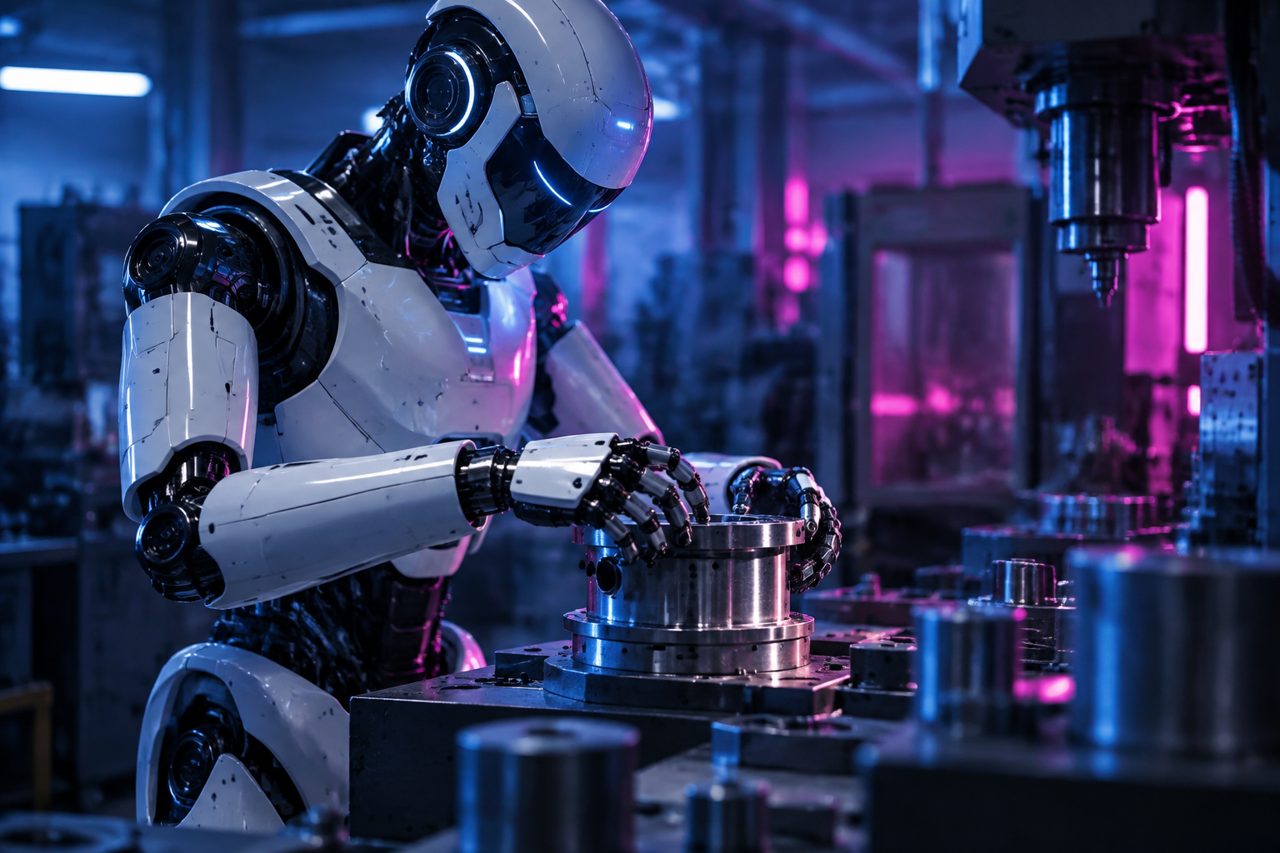
The robot moves forward, picks up a crate and places it on a conveyor. The video lasts thirty seconds, the movement looks natural, and the promise seems enormous. But who prepared the scene? How many attempts failed? Is an operator discreetly controlling the machine? In September 2026, the right question is not whether humanoids are impressive, but whether they deliver a measurable industrial service. Answering it means looking beyond the spectacle and examining operating logs.
From prototype to workstation
The first industrial trials have given the sector substance. In 2024, BMW tested the Figure 02 robot at its Spartanburg plant in the United States on a task involving the handling of car body parts. That same year, GXO and Agility Robotics announced a commercial deployment of Digit, following trials in a warehouse handling Spanx products. These milestones are real; on their own, they do not establish widespread profitability.
Tesla’s demonstrations of Optimus and Boston Dynamics’ work on Atlas have also captured the public imagination. Yet three stages must be distinguished: a capability demonstrated in a laboratory, a pilot at a customer site, and sustained operations backed by service commitments. The forward-looking analysis for 2026 focuses on the transition between these stages, without assuming that every announcement has led to a productive fleet.
The case for humanoids is appealing: working in buildings designed for people without rebuilding the entire shop floor. But two legs and two arms add complexity. A fixed robotic arm, a conveyor or a mobile robot fitted with a manipulator may perform certain tasks more simply. A human shape is an advantage only if it genuinely avoids costly modifications.
Autonomy is measured in missions, not seconds
“Autonomous” can mean many things. A robot may choose its movements while receiving every instruction from a human. It may complete a handling operation on its own but depend on assistance to find its way again. The relevant unit is therefore the complete mission: receiving a request, reaching the workstation, identifying the object, handling it, checking the result and reporting an anomaly.
The first metric is the proportion of missions completed without assistance, measured across a representative sample. Conditions must be specified: identical or varying objects, stable or changing lighting, clear or busy aisles. Success in a prepared work cell does not guarantee reliable operation among relocated pallets and crumpled packaging.
An industrial operator should also ask for the distribution of cycle times, not just an average. A few very slow missions can disrupt a production line. Failures, retries, damaged objects and errors discovered after the fact must all be tracked. A task reported as complete but requiring human correction is not a productive success.
The real test: how often is intervention needed?
Teleoperation is not inherently deceptive. It can be used to train a machine, resolve a problem or ensure a safe start-up. The problem arises when a service presented as autonomous relies on constant assistance that is invisible in the edited video. Every intervention must be counted, timed and classified.
- Guidance: a human identifies the object or specifies the next action.
- Remote takeover: a human directly controls certain movements.
- On-site intervention: a human clears an obstacle, repositions a part or gets the robot back on its feet.
- Maintenance: a human replaces a component or restores operation.
Two measures complement each other: the number of missions between interventions and the human time required per productive hour. A few seconds of assistance is not equivalent to troubleshooting that ties up two technicians. Monitoring must also be counted: an operator expected to supervise several robots may become overwhelmed if they all request help at once.
The decisive test is therefore not “can it work alone?” but “how many machines can a team operate sustainably?” Looking ahead, the most cost-effective advances may come less from a spectacular movement than from a steady reduction in requests for assistance.
Safety is more than a red button
A humanoid can fall, drop a load or trap a hand. Its balance depends on active control systems; its hazard zone changes with its posture and the object it is carrying. Assessment must cover normal operation as well as a loss of communication, a sensor fault or a power failure.
Industrial robot safety standards, notably the ISO 10218 family, and work on collaborative applications provide a foundation. Their application nevertheless depends on the machine and its use. Claimed compliance never removes the need for a risk assessment of the entire workstation, including its tools, loads and human interactions.
Protective stops, near misses and the quality of restarts must be measured. A robot that constantly stops may be cautious but unusable; reducing its safety margins to speed it up would be the wrong response. Useful performance is performance achieved within a validated safety envelope, with procedures that teams can understand.
Cost per task: the ultimate test
The purchase price tells only part of the story. The full cost includes integration, workstation modifications, energy, maintenance, software, support and downtime. Leasing or usage-based billing may simplify budgeting without eliminating these costs: what the contract actually covers needs to be checked.
The relevant calculation divides these expenses by the number of tasks actually completed to the required standard. Charging time, tool changes and restarts reduce that denominator. Claimed battery life is therefore not the same as guaranteed productive time.
Comparisons must be based on the same service delivered: volume, quality, operating hours, flexibility and safety. Automating a physically demanding operation may offer value even without immediate savings. But attributing all the benefits of a reorganization to the robot would obscure its actual contribution. The non-humanoid alternative must also be costed.
Insist on a trial that can fail
A credible pilot begins with acceptance criteria set in advance. It runs long enough to encounter several teams, production variations and routine incidents. The supplier must document exclusions: are certain product variants left out? Does the workstation receive special preparation? Are all interventions included in the results?
The customer must have access to the data, with a consistent definition of each metric. Software changes may improve performance, but they require the periods being compared to be clearly distinguished. The best sign of maturity is not the absence of failure: it is the ability to explain incidents and demonstrate that their frequency is declining.
What next? The next step may be less photogenic: humanoids specializing in a handful of missions, in controlled spaces, with clearly defined supervision. This scenario remains a prospect, not an established outcome. To begin assessing future announcements, four questions will suffice: which tasks can be completed without help, how many interventions are required, what safety has been demonstrated, and what is the cost per task completed to the required standard?