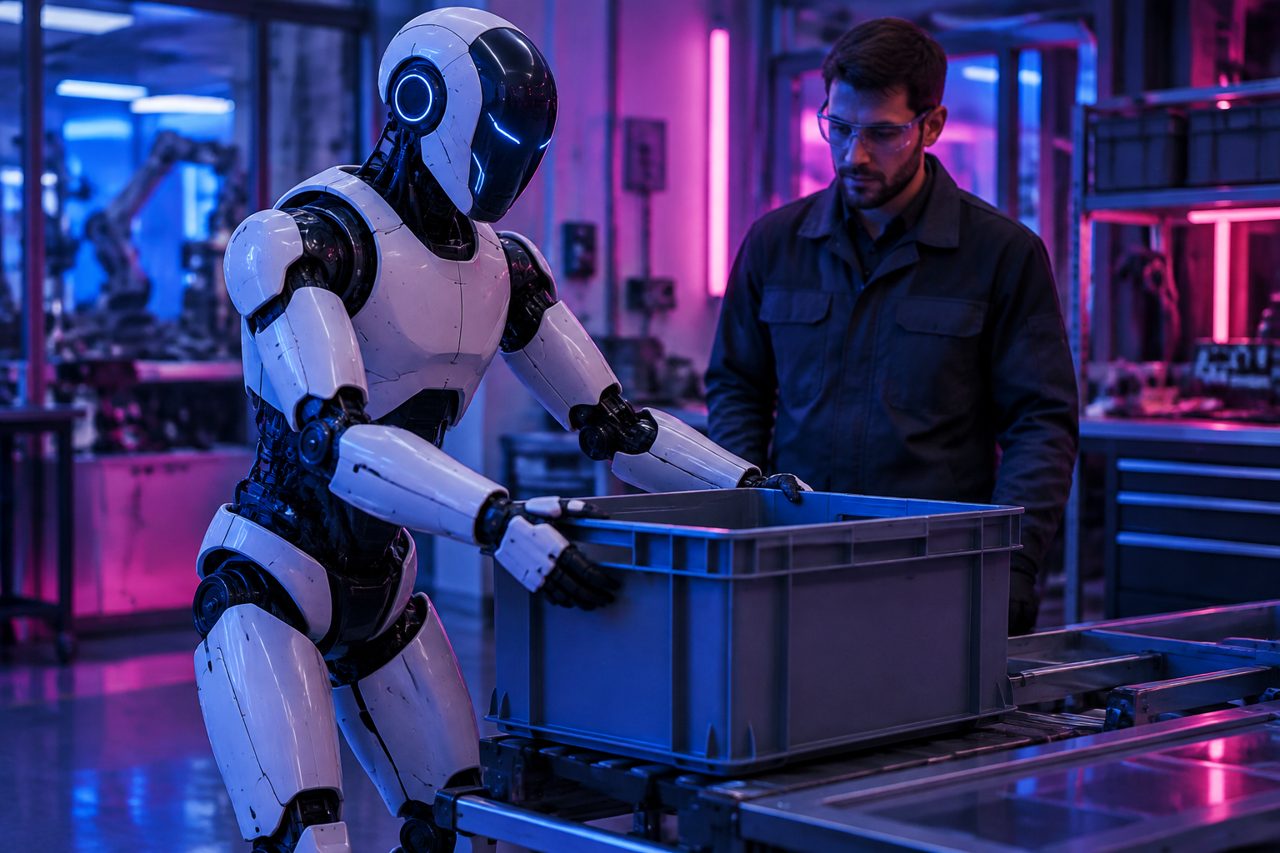
A robot picks up a crate, crosses a workshop and puts it down in the right place. The video lasts thirty seconds. The factory manager, meanwhile, would like to see the rest of the day. How many failed attempts? Who steps in when an object slips? How much does an immobilized joint cost? Looking ahead to September 2026, these are the questions on which the industrial credibility of humanoids hinges. Their progress is real, but moving from an impressive maneuver to profitable work requires much more than a body resembling our own.
Early trials, not yet universal proof
Documented milestones in 2024 show that the sector had moved beyond the laboratory. BMW and Figure had announced an agreement to explore the use of humanoids in automotive production. Amazon had begun testing Agility Robotics’ Digit to move empty totes. In June 2024, GXO and Agility announced a commercial deployment of Digit in a US warehouse, following a pilot phase. These examples demonstrate industrial interest, not broadly proven profitability.
Another signal came in April 2024, when Boston Dynamics unveiled a new, fully electric version of Atlas, replacing its hydraulic predecessor. Behind these very different machines lies a shared ambition: to automate physical tasks in places designed for humans. The outlook for September 2026 presented here remains analysis, not an account of deployments verified as of that date. Announcements, trials and economic results must remain three distinct categories.
The real metric: working without calling someone for help
In a demonstration, success is often measured by the completion of a movement. In a factory, continuity of service must be measured. A humanoid capable of picking up a part may nevertheless fail when that part is out of position, shiny, partially obscured or different from the previous batch. Every exception potentially requires an operator. If that person must leave their workstation to get the machine going again, automation shifts the work rather than eliminating it.
The average time between human interventions therefore becomes a key metric. It does not replace failure measurement: a robot can be mechanically intact yet remain stuck in front of an unfamiliar crate. Technical troubleshooting, remote assistance, replenishment and error recovery must be distinguished. Occasional teleoperation can be useful; constant teleoperation radically changes the economics.
What a rigorous trial should publish
- The number of successfully completed productive cycles as a proportion of all attempts.
- The duration and frequency of human interventions, including remote assistance.
- Availability during production hours, accounting for charging and maintenance.
- The quality achieved, any damage and any stoppages caused around the robot.
These results must cover representative periods, not just the best window of performance. A convincing test includes shift changes, variations in parts and the minor everyday disorder of a workshop. It also documents exclusions: a perfectly clear floor, objects always oriented the same way, immediate intervention by an engineer. These hidden conditions often separate a prototype from a product.
The real cost goes far beyond the price of the robot
The purchase price attracts attention, but says little about the cost of the work delivered. Manufacturers must add integration, peripheral equipment, software, energy, spare parts, training and supervision. Above all, they must put a value on the hours lost when the robot stops. In a just-in-time production flow, a relatively affordable machine can become very expensive if it regularly blocks a neighboring workstation.
The right metric is the cost per operation that meets specifications, completed within the required time and without an invisible transfer of workload to employees. An offering billed by the hour or by the task can make spending more transparent. Yet it does not resolve contractual questions: who pays for an interruption, guarantees spare parts availability and takes responsibility for a drop in performance after an update?
Maintenance deserves particular attention. Articulated hands, gear reducers, sensors, wiring and joints multiply potential points of failure. Dust, repeated impacts and imperfect handling put components under stresses unlike those encountered in a laboratory. A module that can be replaced quickly may matter more than superior dexterity. Without local spare parts stocks, a clear diagnostic procedure and trained technicians, a routine failure could leave the investment idle for a prolonged period.
The human form must justify its presence
Why two legs rather than wheels? Why two arms when one is enough? The argument for humanoids is appealing: they could use existing workstations without rebuilding the entire factory. But that advantage must be demonstrated task by task. On a flat floor, a wheeled mobile robot fitted with an arm may offer a simpler solution. For a repetitive movement, a specialized automated machine often retains an edge.
A more promising setting would be a group of related tasks in an environment poorly suited to fixed automation. Even then, switching tasks must not require several weeks of integration. Profitable versatility is not the theoretical ability to learn a hundred movements: it is the ability to switch quickly between a few useful operations, with known reliability and suitable tools.
Safety imposes its own limits
A mobile humanoid adds risks beyond those of an industrial arm: loss of balance, a dropped load, trapping someone against equipment or a collision while moving. Its familiar shape can also create a false impression of predictability. An employee should not have to guess whether the machine has detected them. Risk assessments must cover the entire workstation, traffic routes and degraded operating conditions.
Reducing speed, limiting forces, monitoring distances or separating certain areas can make operation safer. However, these measures affect throughput and sometimes the project’s economic viability. Applicable standards depend on the machine and its use; the “collaborative” label is not blanket permission to work in close contact. Safety functions must be validated independently of promises about the robot’s intelligence.
The design must also account for human intervention: how can a part be retrieved safely, a stopped machine moved or the robot returned to service? Operators and maintenance staff must take part in trials. They identify constraints that a video overlooks: an obstructed exit, an awkward posture during troubleshooting, an unclear restart procedure. Their training and operational feedback are part of industrial performance.
Moving from pilot to economic proof
A cautious buyer will begin with a clearly defined task, compare several solutions and expand the scope only after validation. The supplier will have to accept measurable acceptance criteria and intervention tracking. The decisive test is not whether the robot succeeds in front of its designers, but whether an ordinary production team can operate it over the long term without exceptional assistance.
What next? Looking ahead to September 2026, the most plausible scenario is not necessarily the arrival of universal mechanical workers, but the advancement of machines assigned to narrow, carefully chosen tasks. The winners could be manufacturers able to make their robots less spectacular and more predictable: repairable, safe and available, with contractual accountability for their performance. The real turning point will come when factories talk less about the demonstration and more about the cost of each part produced.