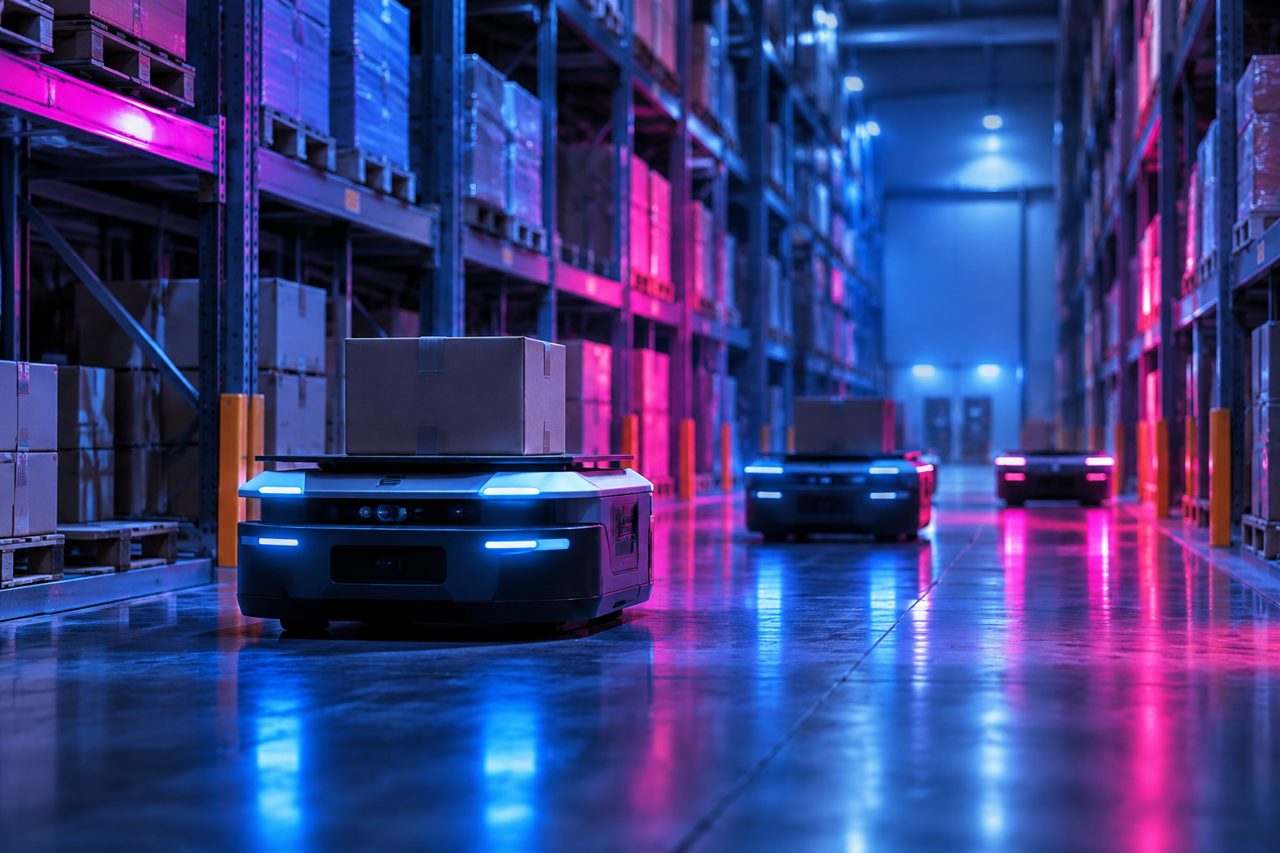
The robot crosses the aisle, navigates around an obstacle and places its tote in exactly the right spot. The demonstration lasts three minutes; the investment commits the warehouse for several years. Behind this apparent seamlessness lies a less spectacular question: how much does each shipped order actually cost? As business picks up again in September 2026, this is the lens through which logistics automation should be examined. Technologies and deployments documented through 2024 provide solid benchmarks; the prospects discussed here remain hypotheses, not established outcomes.
An efficient machine is not necessarily a profitable investment
The word “robot” covers different realities. An autonomous mobile robot transports totes between two workstations. An automated storage system presents products to an order picker. A robotic arm picks up items, with varying degrees of difficulty depending on their shape and packaging. These systems therefore replace neither the same tasks nor the same costs. Comparing their advertised speeds without examining the work performed is like comparing an elevator with a hand.
Large-scale deployments have nevertheless demonstrated that automation can change a site’s economics. Amazon has made robotics a pillar of its industrial operations since acquiring Kiva Systems in 2012. In 2023, the group unveiled Sequoia, which combines storage, tote movement and workstations. AutoStore and the systems developed by Ocado also illustrate the benefits of high-density storage and assisted picking. But the performance of an integrated network is not a promise that can be applied to any warehouse.
Volume matters, but consistency matters even more
The first factor in profitability is actual utilization. A system sized for the November peak may operate well below capacity for the rest of the year. Conversely, equipment designed around average volumes risks becoming overwhelmed precisely when delays are most costly. The right denominator is not the robot’s maximum capacity, but the number of orders actually processed under commercially acceptable conditions.
A steady operation running across several shifts can cover its fixed costs more easily. A highly seasonal operation must compare automation with other options: temporary staff, longer operating hours or partial outsourcing. These solutions are not always available or inexpensive. In a tight labor market, stabilizing output can be worth as much as reducing payroll costs. But that value still needs to be measured rather than assigned an arbitrary benefit.
The relevant volume also depends on the process. A thousand single-item orders do not represent the same workload as a thousand baskets containing several different products. Order lines, units handled, distances traveled and required replenishment all need to be examined. A robot that speeds up picking without improving the flow through packing simply moves the queue. Overall throughput remains limited by the workstation that cannot keep up.
The product catalog is the real test
In a demonstration, boxes are often clean, rigid and properly oriented. In a warehouse, a fabric pouch collapses, transparent packaging confuses vision systems and two items get caught together. Advances in vision and gripping have expanded what is possible without eliminating exceptions. A system that excels with standardized cartons may perform poorly when faced with a varied assortment.
Before signing, buyers therefore need to test a representative sample, including slow-moving products and difficult cases. What percentage of the catalog can be handled without intervention? How many seconds does a manual correction take? What happens to an item that cannot be grasped? A good average sometimes conceals a minority of incidents that tie up an entire team. Returns, with their opened packaging and varying conditions, make this issue particularly important.
Segmentation often offers a better answer than full automation. Standard products follow a robotic workflow; fragile, bulky or unusual items remain in a process suited to them. This hybrid model requires rigorous coordination, but avoids paying for complex technology to address every case. Automating the main flow can be more profitable than trying to automate every product line.
Integration: the second bill
The hardware price does not capture the full investment. Interfaces with warehouse management software, building modifications, safety equipment, connectivity, training and maintenance all add to the cost. Sometimes product data must be reworked, totes modified or replenishment reorganized. These tasks are less photogenic than an articulated arm, yet they determine its actual productivity.
The transition also carries a cost. During ramp-up, old and new processes may coexist. Teams support testing while orders continue to arrive. An integration delay or throughput below expectations can require overtime. The budget must account for this transition, as well as degraded operations: what happens when the system stops, and how long can the warehouse cope?
Subscription-based robotics offerings can reduce the initial outlay and provide greater flexibility. They do not eliminate interfaces, training or dependence on the supplier. Buyers need to examine the commitment period, minimum charges, included services and exit terms. An affordable monthly payment can conceal a high cost if volumes fall or every modification becomes an additional paid service.
Building a credible break-even calculation
The calculation must start with a realistic scenario without robots, not a deliberately inefficient warehouse. The first step is to quantify what a better layout, reliable data or a different organizational approach could deliver. Then all cash outflows and expected gains must be compared over the same period. The payback period provides an initial benchmark; a discounted cash flow analysis offers better insight into long-term commitments.
- Count achievable savings: freed-up hours become savings only if staffing levels, overtime or hiring actually change.
- Value demonstrable gains: fewer errors, additional capacity that can generate sales, freed-up space or fewer accidents, without double counting.
- Stress-test for unwelcome surprises: lower volumes, a delayed launch, more expensive maintenance and availability below expectations.
A pilot must replicate these constraints, not merely confirm that the machine works. The decisive indicators are cost per order, sustained throughput, human interventions and on-time performance, across several activity profiles. Contractual commitments must specify measurement conditions and responsibilities. A guaranteed throughput rate with an ideal assortment offers little protection when handling the actual catalog.
The operational choice behind the technology choice
What next? From September 2026 onward, a plausible trajectory would be toward more selective automation: modules added gradually, hybrid workflows and contracts more closely tied to the service delivered. Software advances could expand the range of products that can be handled, without eliminating physical constraints or integration costs. For buyers, the best question will therefore remain less “what can this robot do?” than “what costly problem does it solve, at our volume, every day?”.