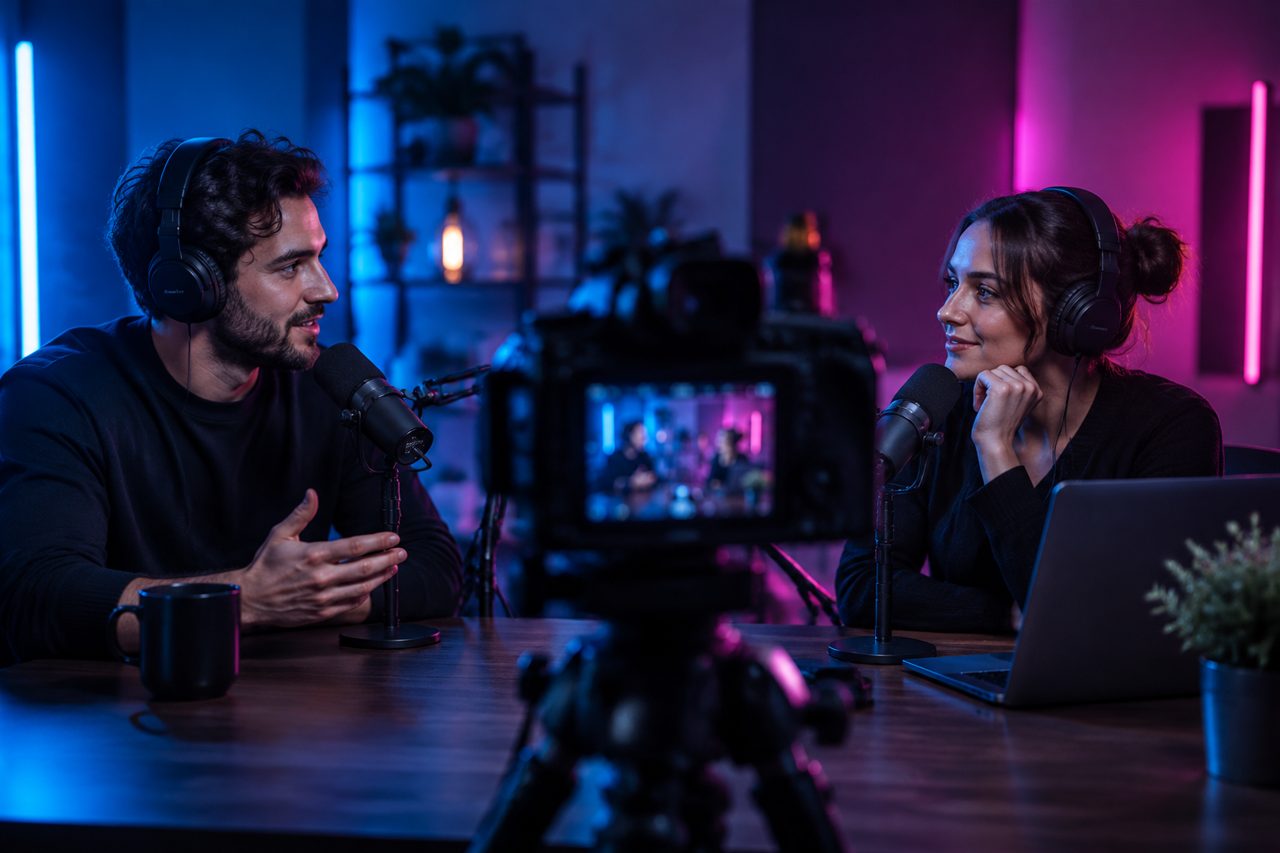
Three microphones, two cameras, a sofa: the setup has become a communications pitch in its own right. Record a compelling conversation, publish it on YouTube, then cut the highlights for social media. On paper, every interview becomes a small content factory. In practice, filming can also turn a good podcast into an expensive show that nobody really watches. The question, then, is not whether brands can produce video, but what it adds to what they have to say.
The camera: distribution’s new default
The convergence of podcasts and video is not some futuristic hypothesis. In 2023, YouTube integrated podcasts into YouTube Music in the United States before expanding their availability. Google subsequently arranged the shutdown of Google Podcasts and the migration to YouTube Music. Spotify, meanwhile, already offered video podcasts and was expanding access to the feature for creators. These moves blurred the line between shows to listen to and programs to watch.
For a brand, the appeal is obvious. YouTube can help reach audiences through search and recommendations, whereas an audio podcast often has to build discovery elsewhere. A face, a demonstration or an interaction can help hold attention. But a presence on a platform guarantees neither distribution nor an audience: a filmed conversation immediately competes with videos designed for the screen.
A note on methodology: this analysis, framed from the perspective of September 2026, draws on developments documented through June 2024. The possible developments discussed are forward-looking scenarios, not a verified assessment of platforms in 2026. The trend suggests a convergence in usage, not the inevitable disappearance of audio.
Film what, for whom, and to show what?
A laboratory manager explaining a prototype with the object in front of her gives people a reason to watch. So does an architect discussing plans. By contrast, two executives reciting generalities in front of a wall of logos do not automatically create a visual experience. Before booking a studio, one question is often enough to clarify the project: what would the audience miss by closing their eyes?
If the answer is “almost nothing,” audio can remain the primary format. It accompanies walking, commuting or certain tasks without demanding visual attention. This flexibility is not a weakness to be corrected. It offers practical value, particularly for long, technical or intimate subjects. Adding visuals can broaden access; requiring people to watch can narrow it.
The camera also changes the conversation. Some guests become more precise and expressive. Others monitor their posture, their facial expressions and their hesitations. In a company, where statements sometimes pass through several layers of approval, the setup can reinforce self-censorship. The paradox is troubling: investing more to get a blander, and therefore less interesting, discussion.
The true budget goes beyond filming
Comparing the price of a microphone with that of a camera tells you almost nothing about the full cost. Video adds framing, lighting, set design, synchronization, graphics and the management of larger files. It also calls for thumbnails, checked subtitles and several versions adapted to different screens. Even with a lightweight setup, someone has to check the result.
The most underestimated expense is often internal staff time. Who prepares the guest? Who identifies the segments? Who approves sensitive passages? Who responds to comments? An hour of conversation can involve communications staff, legal teams and subject-matter experts far beyond the recording itself. Transcription and automated clipping tools speed up certain tasks; they do not replace editorial judgment.
Costs must therefore be assessed per episode actually published and put to use, then per meaningful outcome. A sophisticated but irregular production may be less appropriate than a reliable audio series. Conversely, a simple visual format, batch-recorded with an experienced team, can strike the right balance. Cost-effectiveness depends on the production system, not just the equipment.
Short clips: a showcase or an illusory return?
The sales pitch is appealing: one long interview could yield a multitude of clips. Yet not every conversation contains a dozen standalone moments. A good short segment must quickly frame a question, offer something of value and remain understandable out of context. Mechanical cutting mainly produces fragments that begin too late or stop before the key point.
Another common misconception is assuming that someone who watches a few seconds will go on to watch an entire episode. Watching a clip and listening in depth are two distinct behaviors. The transition from one to the other must be measured, not assumed. A clip can nevertheless serve a purpose of its own: introducing an expert, explaining a concept or establishing an association between the brand and a topic.
The danger arises when an interview is designed to generate sound bites. Opinions harden, nuance becomes a burden and guests learn to manufacture hooks. For a brand that claims expertise, this apparent gain in visibility can undermine credibility. Three strong clips are better than a string of contrived provocations.
Measuring more than the view count
Metrics must follow from the objective. To build awareness, examine reach among the intended audience and audience retention. To nurture professional relationships, relevant feedback, sign-ups or attributable sales conversations will matter more. To explain a complex topic, time spent watching or listening and the questions received will provide clues, without proving understanding on their own.
Beware of misleading comparisons: a video view is not equivalent to an audio download. Definitions and usage contexts differ. Adding all the counts into a single report can conceal audience overlap. A useful dashboard distinguishes between channels and, above all, shows whether people return.
Choosing a setup rather than following a trend
- Audio first: for substantive discussions, small teams or guests who are uncomfortable on camera.
- Full video: when gestures, objects and interactions warrant watching, with a sustainable, regular publishing schedule.
- A hybrid approach: an audio podcast accompanied by explanatory videos or separately filmed segments, rather than an interview filmed by default.
The best test remains a short pilot series, with a capped budget and criteria set before publication. It allows teams to compare the additional effort with the attention actually gained, then simplify without seeing that choice as a step backward.
What next? Looking ahead from September 2026, tools could continue to reduce production friction without making attention any less scarce. Brands will probably gain less from filming everything than from choosing more carefully what deserves a screen. Conversation will remain at the heart of the format: a clear idea, a credible speaker and attentive listening. The camera should serve those elements, not stand in for a strategy.