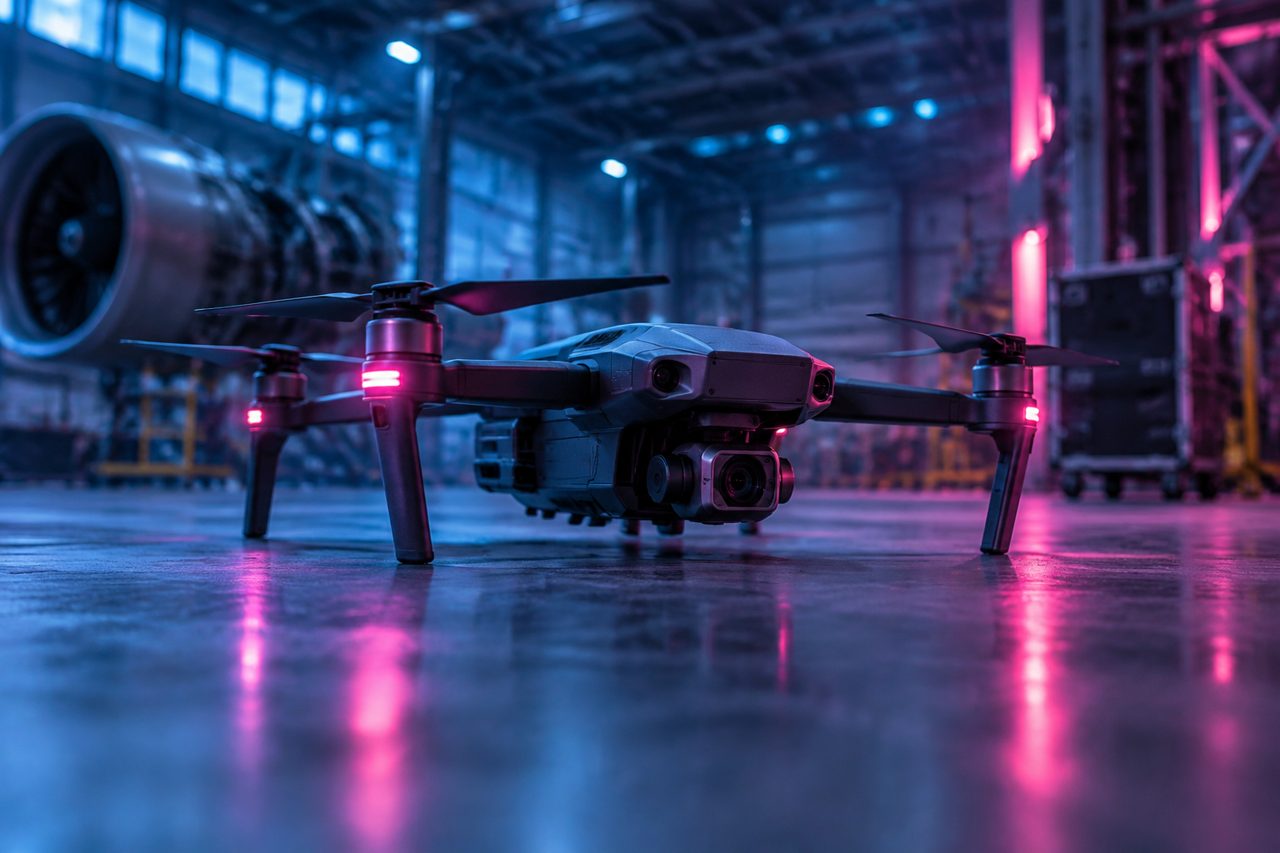
A drone impresses on a test range. Software detects an intrusion. A satellite image reveals unusual activity around a port. For their developers, the demonstration feels like a victory; for their cash reserves, it is often just the start of the ordeal. In defence, an urgent need does not automatically translate into a quick order. Looking ahead to September 2026, dual-use technologies, suitable for both civilian and military applications, point to a promising market. But the journey from prototype to delivery still needs to be financed.
A market driven by a strategic shift
The full-scale war launched by Russia against Ukraine in 2022 put industrial capacity back at the heart of European defence policy. It also demonstrated the importance of drones, resilient communications, commercial intelligence and electronic warfare. In France, the 2024–2030 Military Programming Law sets out €413 billion in planned requirements. However, that figure does not amount to an order book readily accessible to young companies.
Bridges have been established: France’s Defence Innovation Agency, the European Defence Fund, NATO’s DIANA accelerator and the NATO Innovation Fund. Their roles differ: funding research, supporting trials or making equity investments. None removes the need to find a buyer and secure a viable contract. This analysis looking ahead to September 2026 draws on these developments already under way; the outlook presented here is not an account of orders actually placed by that date.
Three attractive fields, three different economic models
Drones: hardware is no longer enough
Drones are the most visible showcase for dual-use technology. A platform designed to inspect power lines can provide useful building blocks for military surveillance: navigation, image processing, autonomy or transmission. But moving from a relatively controlled civilian environment to one subject to jamming fundamentally changes the product. Resistance to interference, secure communications and field maintenance become just as important as advertised performance.
The Ukrainian experience has highlighted the speed of adaptation and the attrition of equipment. For a company, this poses a difficult challenge: improving the system frequently without making production unmanageable. Batteries, radio components, sensors and motors must remain available and traceable. A prototype assembled by engineers demonstrates neither industrial production rates, nor stable unit costs, nor the ability to repair hundreds of aircraft.
Cybersecurity: recurring revenue, with conditions
Cybersecurity offers greater scope for immediate sales to civilian customers. Industrial companies, hospitals and infrastructure operators share military needs for detection, protection and continuity. The EU’s NIS2 directive, adopted in 2022, strengthened the framework of requirements applying to many organisations. This supports potential demand without guaranteeing that every new software vendor will find a place in an already competitive sector.
Access to sensitive environments brings stricter requirements: hosting under controlled conditions, access controls, auditability and operation on isolated networks. Depending on the product and market, qualification by ANSSI, France’s national cybersecurity agency, can become decisive. An offering designed for automated cloud deployment may then require a dedicated version, on-site work and security-cleared staff. The revenue looks like that of a software business; the costs can resemble those of a services company.
Space-based observation: selling a decision, not just an image
The use of commercial satellite imagery to monitor the war in Ukraine has made its value tangible. But space-based observation encompasses several businesses: building satellites, operating a constellation, distributing imagery or producing analysis. Their capital requirements differ greatly. A company that detects changes in ports using purchased data avoids some of the risks associated with space operations, but depends on its suppliers.
Customers pay primarily for actionable information delivered on time. Cloud cover for optical imagery, revisit frequency, transmission delays and usage rights therefore shape the commercial proposition. Civilian markets—insurance, agriculture and environmental monitoring—can diversify revenue. They do not necessarily buy the same products, at the same prices, as military customers.
The valley of death is also administrative
The main misunderstanding stems from confusing interest, trials and procurement. An operational team may value a technology without controlling the budget needed to buy it. A successful trial may lead to another evaluation rather than deployment. Negotiated procedures, innovation partnerships and other procurement tools can ease the process; they do not eliminate budget trade-offs or security requirements.
Nor is there any universal “defence certification”. Depending on the application, a company will have to address airworthiness, electromagnetic compatibility, IT security, protection of classified information or environmental qualification. For exports, controls on dual-use goods and military equipment may require authorisations. The presence of foreign components can also complicate access to certain markets. These constraints must be built into the sales timeline from the design stage.
Cash flow: the real proving ground
The danger is not just selling too late. It is also having to spend before getting paid: hiring, building inventory, reserving manufacturing capacity and paying for tests. A grant may fund part of development, but not the entire production ramp-up. An order can itself create a working capital requirement if purchases from suppliers significantly precede customer payments.
Financial discipline therefore means negotiating payment schedules as carefully as prices. Deposits, milestone payments, funding for tooling and explicit acceptance criteria reduce uncertainty. For investors, the quality of the order book matters more than its headline value: firm contracts or expressions of intent, margins after support costs, dependence on a single programme. A letter of interest does not pay salaries.
Choosing a path rather than building everything
Dual-use works when civilian and military markets genuinely share a technological foundation. Otherwise, the company is funding two products, two sales strategies and two support organisations. It is better to identify early what remains common and charge for application-specific adaptations. Partnering with a major industrial group can ease integration and access to programmes, at the cost of shared margins and sometimes reduced control over the customer relationship.
What next? For September 2026 and beyond, the most plausible scenario is one of growing but unevenly distributed opportunities. Sovereignty and resilience needs could favour European suppliers able to deliver, maintain and upgrade their solutions. The decisive criterion would then no longer be spectacular innovation alone: it would be the ability to turn a technical proof of concept into repeatable production without exhausting the available capital before the first production run.