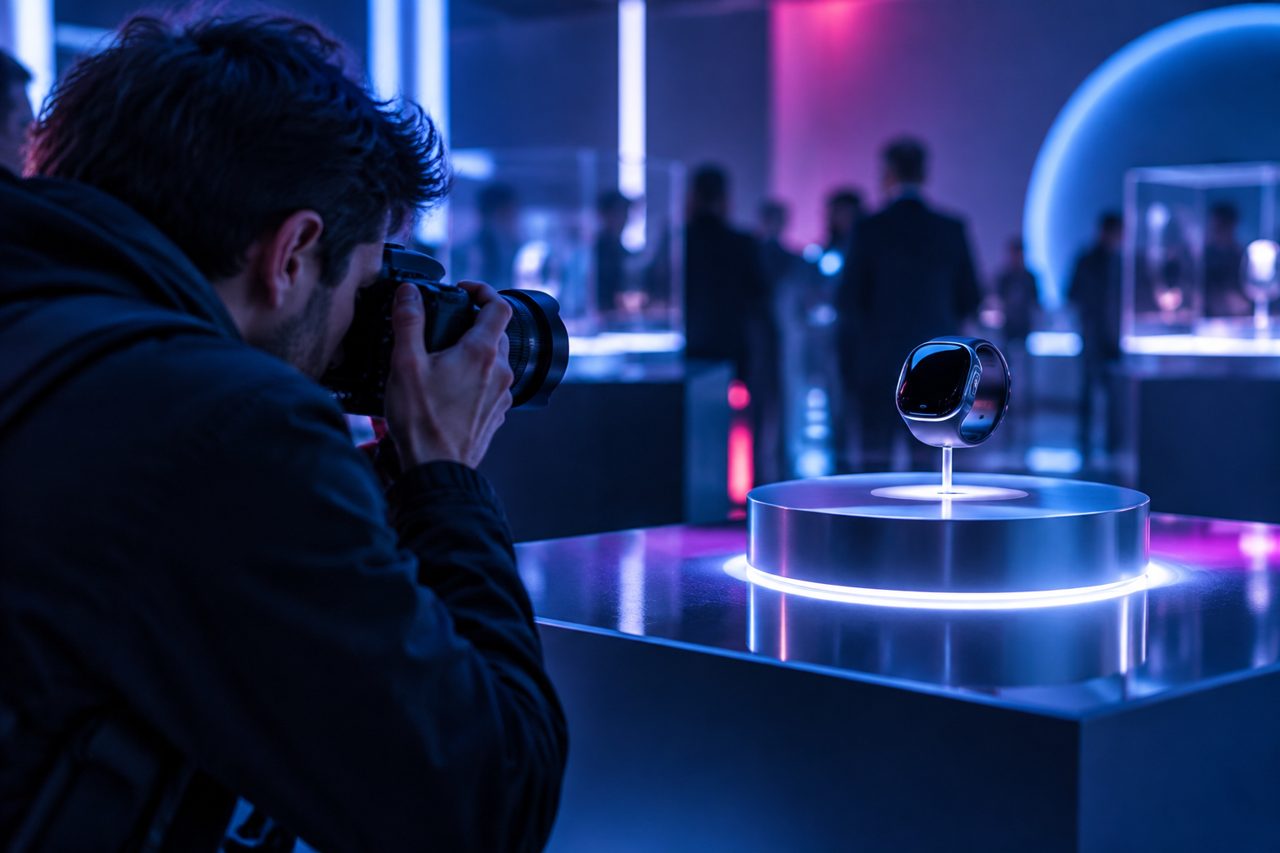
A robot crosses a spotless kitchen. A transparent screen reveals the setting behind it. An assistant promises to organize a trip for you. At CES, a few seconds are enough to produce a viral image. They do far less to explain what will actually go on sale. Between spectacle and information, communications professionals must make the promise verifiable. As the next trade show cycle approaches this September 2026, that distinction remains crucial: a newsroom is not simply looking for something new to show, but for a story it can tell without becoming an extension of the booth.
Spectacle opens the door, but it is not everything
CES encapsulates a classic challenge in technology communications: hundreds of companies simultaneously demand the attention of journalists with little time to spare. A visual demonstration therefore has an obvious advantage. It is quickly understood, provides footage and makes it possible to pitch a story to a newsroom immediately. But that effectiveness also encourages shortcuts: one successful movement becomes a general capability; a smooth interface becomes proof of a finished product.
The transparent televisions presented by LG and Samsung at CES 2024 illustrate this mechanism. The visual impact was undeniable. Yet the announcements did not describe the same thing: LG presented its OLED T as a television intended for commercial release, while Samsung unveiled transparent Micro LED display technology. For journalists, that difference is central. For communications professionals, spelling it out prevents an appealing headline from turning a technology demonstration into a commercial promise.
The first requirement: specify the level of maturity
Prototype, concept, pre-production unit, available product: these terms are not interchangeable. A prototype can prove that a mechanism works without demonstrating that it will be reliable, manufacturable at scale or acceptably priced. A pre-production unit may still change. A preorder, meanwhile, signals an intention to sell, not delivery. The first evidence to provide is therefore a clearly understandable status, along with what still needs to be validated.
This precision also protects the company. If a robot works only in a mapped environment, it is better to say so before the demonstration. If it relies on a remote connection or human intervention, that dependency belongs in the story. The problem is not necessarily that a technology is incomplete: CES legitimately provides a platform for research and exploration. The problem arises when the presentation conceals the limitations that govern real-world use.
The evidence must hold up beyond the booth
A good demonstration answers a specific question. Does the system recognize a request phrased differently? Can the robot navigate around an unexpected obstacle? Does the device work without the trade show’s network? Not every check is possible on site. But a brand can propose a testing protocol, explain the test conditions and distinguish observed results from its objectives. An edited video is no substitute for that opportunity to examine the product.
For AI-powered products, this discipline becomes essential. The Rabbit R1, presented at CES 2024, notably promised to simplify interaction with digital services. The first independent reviews published after deliveries subsequently highlighted limitations in reliability and functionality. The lesson extends beyond this device: a promise of autonomy must be assessed through complete tasks, not merely through the quality of an answer or the elegance of an interface.
A press kit built on evidence rather than adjectives
Press materials should make it possible to verify the main claims without extensive back-and-forth. A few elements are enough to improve the quality of coverage:
- The exact status of the device on display, including any differences from the commercial model.
- The demonstration conditions: connectivity, preparation, human intervention and restrictions.
- Documented test results, the methodology and the identity of those who conducted the tests.
- Access to someone capable of answering technical questions beyond the marketing messages.
This approach does not guarantee a favorable article. It offers something better: an informed article. An acknowledged limitation can become a point of analysis rather than grounds for suspicion of concealment. Conversely, a claim that cannot be verified forces journalists either to explicitly describe it as a promise or to leave it out.
The timeline is part of the product
“Coming soon” is not a timeline. For a French readership, a launch announcement must specify the markets involved, the sales channel, the features available at launch and those announced for later. Pricing deserves the same rigor: final or indicative amount, whether taxes are included, any required subscription and necessary accessories. Without that information, it is impossible to make a meaningful comparison with solutions already available.
Samsung’s Ballie home robot, shown at CES 2020 and then in a new version in 2024, is a reminder that the same name can span several stages of development. A return to the stage is not enough to establish availability. Sound editorial practice means reconstructing the timeline of announcements. Sound communications practice means providing that timeline, explaining what has changed rather than presenting every stage as a fresh beginning.
Use turns an object into a story
A news story truly begins when readers understand who faces what problem. A transparent screen does not offer the same value in a living room, a shop window or an exhibition space. A voice assistant may simplify a task for someone with motor impairments while adding an unnecessary step for someone who already uses their phone efficiently. Context determines relevance; a specifications sheet is no substitute.
That means showing an everyday scenario, including its friction points: setup, learning, maintenance, errors and repairs. For a connected device, data handling and the duration of software support are also part of the user experience. A successful demonstration should allow journalists to describe a day with the product, not just thirty seconds in front of it. This is often where the difference between an appealing invention and a genuinely useful proposition becomes clear.
Communications that welcome scrutiny
The best press preparation is not training in how to dodge difficult questions. It is a joint effort by communications, engineering and sales teams to produce consistent answers. If the date still depends on certification or a manufacturing partner, that dependency must be identified. If a demonstrated feature is not planned for launch, it must be presented as such. This candor reduces the ambiguity on which hype thrives.
What next? At future CES events, the proliferation of AI demonstrations can be expected to make independent evidence even more valuable. This is not a certainty about future products, but a plausible consequence of promises that are increasingly easy to stage. Communications professionals would benefit from organizing post-show follow-up before the doors open: extended testing, scheduled progress updates and access to teams. Spectacular visuals will remain a catalyst. An enduring story will rest on what holds up once the spotlights are switched off.