The cloud has beaches, equipment rooms and ships’ hulls. When a company backs up its data on another continent, its packets often cross the ocean through optical fibers laid on the seabed. This discreet infrastructure carries the vast majority of intercontinental communications. And its robustness depends on more than the number of cables: it rests on the routes they take, the places where they come ashore and how quickly they can be repaired.
By September 2026, these issues are likely to carry greater weight in the decisions of operators and cloud customers. This outlook builds on documented trends, notably the cable outages in the Red Sea and off West Africa in 2024. They underscored a simple fact: digital networks can route around a failure, but they cannot abolish geography.
The Cloud Rests on Glass Threads
A submarine cable is not a large pipe filled with data. It is an assembly of fibers, protective layers and electrical components that power repeaters over long distances. Near coastlines, it may be armored and buried to limit damage from anchors or fishing activities. In deep water, it generally rests on the seabed, far from routine human activity.
Its capacity is not fixed for its entire lifespan. Optical equipment installed on land can be upgraded to make better use of existing fibers. But increasing throughput does not create a second route. Even an extremely high-performance link remains a vulnerability if all essential communications must pass through it.
Satellites provide valuable solutions for remote areas, emergencies and certain mobile applications. However, they cannot replace the entire network of ocean links with comparable capacity. For large-scale exchanges between data centers, cables remain the backbone: distributed storage, database replication, video, business services and content delivery all depend on them.
Two Cables Do Not Always Mean Two Routes
In a sales presentation, redundancy looks like two lines connecting two continents. On a nautical chart, those lines can run dangerously close together. Two separate cables crossing the same narrow passage, following the same underwater slope or arriving on the same stretch of coastline remain exposed to a single event.
The right question, then, is not “how many links?” but “how many independent risks?” An earthquake, an underwater landslide or an incident involving a vessel can affect several neighboring systems. The multiple outages observed off West Africa in March 2024 illustrated this vulnerability: having several cables in a region does not guarantee sufficient geographic diversity.
The incidents in the Red Sea, also in 2024, demonstrated the importance of corridors that concentrate traffic between Europe and Asia. Without automatically attributing every break to sabotage, they highlight the need to treat conflicts, navigation restrictions and access to territorial waters as technical parameters. An alternative route may exist, but it lengthens the journey and may have less spare capacity.
Detours Come at a Cost
The internet can reroute traffic. But operators still need the necessary agreements, equipment and capacity. When a major route goes down, backup paths can become congested. Services remain accessible, but response times increase, transfers slow and some applications become frustrating to use.
For a business, using multiple providers is not an absolute guarantee either. Two operators may buy capacity on the same cable. Two cloud regions may share part of their connectivity. Companies therefore need to examine the physical dependencies behind their contracts, then test failover under realistic conditions, rather than simply checking that a “backup” option appears on an invoice.
At the Landing Point, the Ocean Meets Other Vulnerabilities
The journey does not end at the beach. A landing chamber provides the transition to the terrestrial network, while a station houses the equipment needed to operate the system. Power, cooling, security and the fibers connecting to data centers then become just as important as the submerged segment.
An intact cable can be rendered unusable by a failure on land. And two stations far apart may still rely on the same electrical substation or the same road crossing for their terrestrial links. Resilience must be verified end to end, right through to applications and data replication mechanisms.
Cities such as Marseille have become hubs thanks to the convergence of cables, terrestrial networks and data centers. This concentration makes interconnection easier and attracts investment. It also creates a trade-off: benefiting from a dense ecosystem without concentrating all dependencies there. Diversifying landing points sometimes means financing infrastructure with less immediate financial returns.
Repair: An Industrial Operation, Not a Reboot
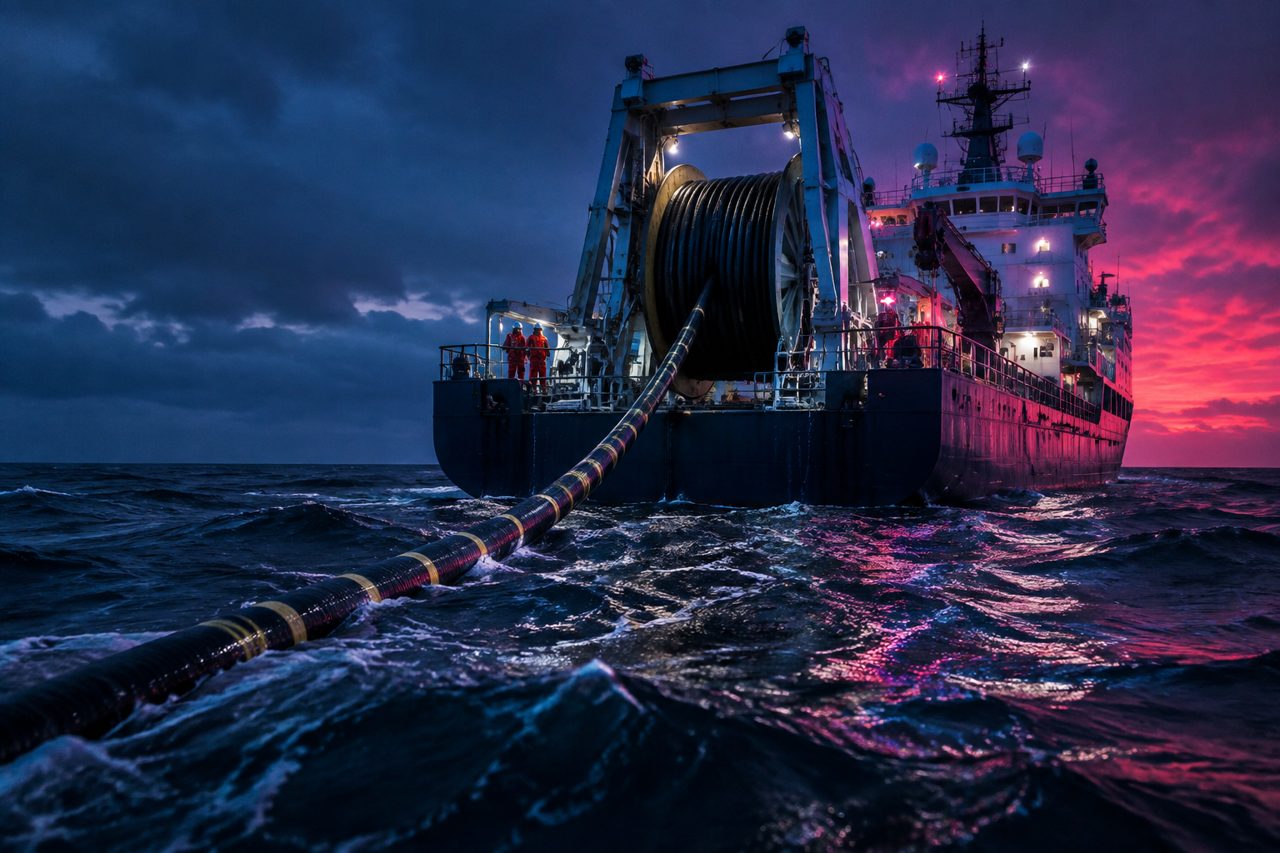
When a fiber breaks, no software patch can splice it back together. Teams locate the fault using measurements, then mobilize a cable ship. Depending on the depth and conditions, the vessel retrieves the cable with suitable tools, brings the ends to the surface, inserts a replacement section and returns the assembly to the water after testing.
The repair itself accounts for only part of the delay. It requires a vessel available in the right area, compatible parts, favorable weather and the necessary permits. A regional crisis can complicate access. Several simultaneous breaks can also strain shared maintenance resources.
This repair capability matters as much as transmission capacity, even if it is harder to sell. Cable stocks, maintenance agreements and crew availability constitute a form of collective insurance. Building more without strengthening these resources could widen the gap between the network’s reach and the ability to restore it.
The Cloud Must Show Its Backup Routes
Major digital service providers have become significant investors in submarine cables, either on their own or through consortia. They aim to meet their needs, control costs and connect their locations. This can add routes, but a new cable does not automatically benefit everyone: access depends on commercial agreements and the networks available on land.
For business customers, the priority is to ask for evidence rather than an abstract promise of availability: diverse corridors, independent terrestrial landing points, capacity reserved for backup and recovery drills. Not all sensitive information will be made public. It can nevertheless be reviewed within an appropriate contractual framework.
What comes next? Through September 2026 and beyond, demand driven by cloud computing and artificial intelligence could spur further investment. Yet real progress will not be measured solely by advertised throughput. It will require more independent routes, better-protected stations and maintenance capabilities that can keep pace. The most resilient cloud will be the one that has planned not only where to send data, but how to keep operating when a part of the ocean falls silent.