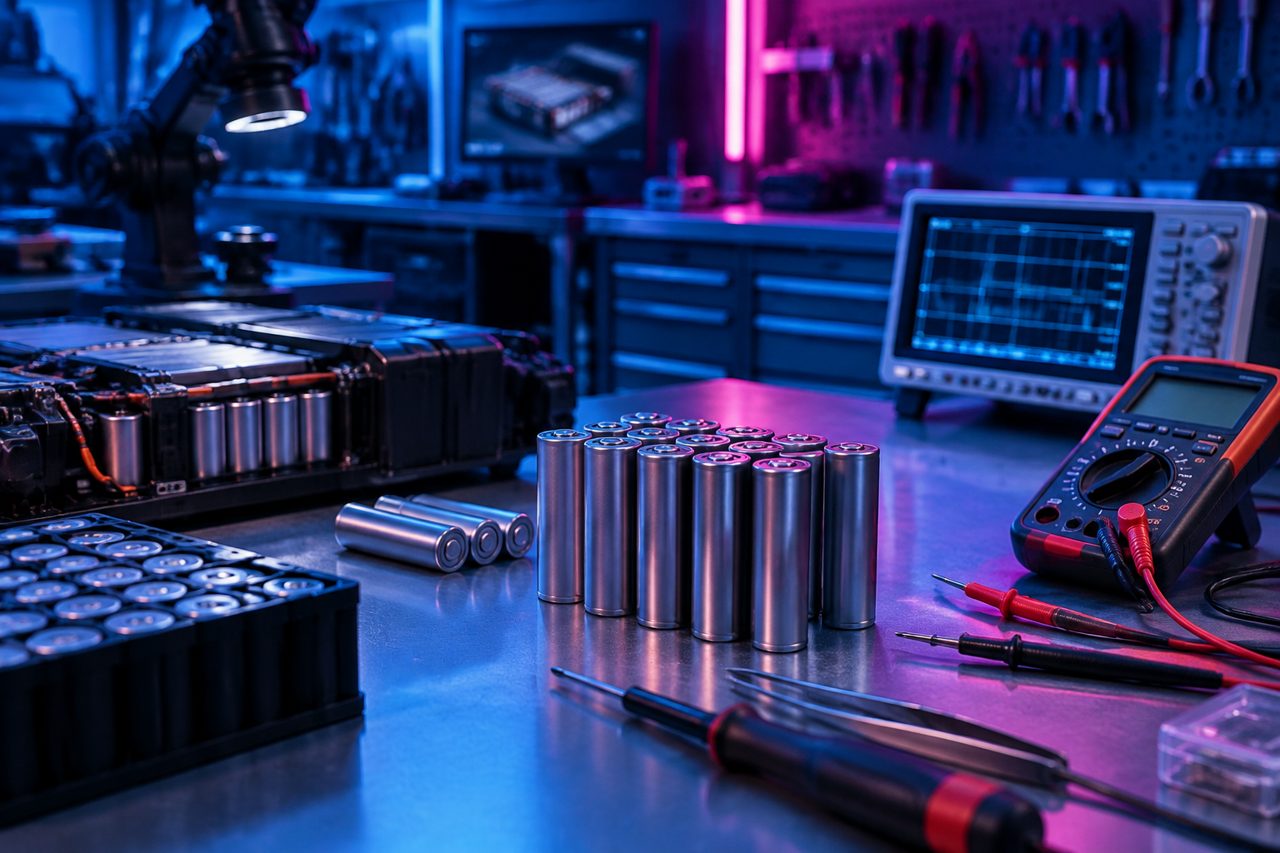
A small car running without lithium in its battery, a warehouse storing solar electricity using sodium: the promise is becoming an industrial reality. But replacing one chemical element is not enough to transform a market. For this analysis looking ahead to September 2026, we must distinguish documented achievements from future prospects: sodium-ion has genuine strengths, without offering a universal solution. Its role will depend less on a race for range than on the balance between price, size, performance and security of supply.
Sodium enters the race
A sodium-ion battery works on a principle similar to that of a lithium-ion battery: ions move between two electrodes during charging and discharging. Sodium replaces lithium as the charge carrier. However, this is not simply a matter of changing one ingredient in an existing recipe: electrode materials, electrolytes and processes must be adapted.
The technology has now moved beyond the laboratory. CATL unveiled a first generation of sodium-ion cells in 2021. In late 2023, JAC and manufacturer HiNa announced a small electric car equipped with the technology in China. In 2024, stationary sodium-ion installations also entered service in the country. These milestones demonstrate industrial feasibility, but not yet established competitiveness across all applications.
In France, Tiamat, which emerged from CNRS research, has focused in particular on cells prioritizing power and fast charging. A useful reminder: sodium-ion is not a single chemistry. Depending on the materials chosen, a battery can target cost, longevity, cold-weather performance or power, with different trade-offs.
Cheaper in theory, not automatically at the factory
The economic argument starts with the resource. Sodium is abundant and widely distributed. Its supply does not face the same potential pressures as lithium. Several sodium-ion chemistries also eliminate the need for nickel and cobalt, but this advantage is not exclusive: lithium iron phosphate batteries, known as LFP, do without them too.
Another possibility is to use aluminum as the current collector on both electrodes, whereas conventional lithium-ion batteries generally use copper on the anode side. This can reduce certain costs and make some components lighter. But the final bill also includes separators, electrolyte, casing, electronics, energy consumed at the factory and cells rejected during quality control.
Sodium-ion’s real economic competitor is therefore LFP manufactured at very large scale. That technology benefits from factories whose capital costs have been recovered, numerous suppliers and years of optimization. The fall in lithium prices after the peaks of 2022 has also reduced the economic urgency of finding a substitute.
A sodium-ion cell could become cheaper once the technology matures without being cheaper today. Comparisons must involve equivalent products from comparable factories and distinguish the price of a cell from that of a complete system. A cheap raw material alone never guarantees a cheap battery.
Energy density sets the limits
The main drawback remains the amount of energy stored per kilogram and per liter. The first industrial generations of sodium-ion cells generally fall below the best lithium-ion cells intended for vehicles. Some industry announcements suggest a narrowing gap with LFP, but the figures depend heavily on the chemistry and measurement conditions.
For the same amount of energy on board, lower density means greater mass or volume. Once the cells are integrated into a pack, structures, connections, protection and thermal management must also be added. Performance figures announced at cell level therefore do not directly describe a car’s range.
This limitation does not doom the technology: it determines its applications. For a sedan used on highways, every kilogram counts. For stationary equipment with space available, the trade-off may be acceptable. Between the two, small vehicles making predictable journeys offer promising territory.
Mobility: finding the right fit rather than driving ever farther
Small cars and local fleets
A city car used for shopping, commuting or a short delivery route does not have the same requirements as a family vehicle used for long holiday trips. If its daily range remains sufficient, a sodium-ion pack could offer a worthwhile compromise, provided its installed cost is genuinely lower than that of LFP.
Captive fleets offer a particularly favorable setting: known mileage, depot charging and organized maintenance. Small commercial vehicles, industrial-site vehicles and some two-wheelers could benefit. For very compact vehicles, however, available space can sometimes be as much of a constraint as weight.
Cold weather and power: strengths that need verification
Some sodium-ion formulations show promising performance at low temperatures or during fast charging. However, available power, recoverable energy and the ability to accept charging in cold conditions must be distinguished. These qualities need to be verified on the complete pack after aging, rather than inferred from an isolated demonstration.
Architectures combining sodium-ion and lithium-ion cells have also been proposed. They could combine the strengths of both, but complicate management electronics and integration. Sodium-ion appears to be a less natural fit for long-haul heavy trucks or cars seeking maximum range.
Stationary storage: the most obvious market?
Alongside a solar farm or behind a commercial building, a few additional tonnes are often less of a drawback than in a vehicle. Sodium-ion could therefore aim to shift solar output into the evening, curb peak demand or provide grid services.
The right metric, however, is not simply the price per kilowatt-hour of installed capacity. Operators consider the cost of the electricity actually delivered over the system’s lifetime: efficiency, cycle life, maintenance, availability and financing also matter. A cheaper but less durable battery can lose its entire advantage.
Safety calls for the same caution. Sodium-ion does not mean nonflammable: many cells use organic electrolytes. Thermal runaway testing, detection and containment remain essential. Finally, the technology does not automatically solve seasonal storage: its plausible applications remain, in particular, storage lasting a few hours.
The decisive battle will be industrial
Manufacturers can reuse some lithium-ion equipment and expertise, but conversion is not simply a matter of changing the label. The hard-carbon anode common in sodium-ion cells requires suitable precursors and consistent quality. Humidity, cell formation and production yields must be controlled.
Insurers, banks and customers must also be won over with long-term warranties and aging data. Recycling will need to become economically viable despite sometimes lower recoverable material values. Diversifying battery chemistry reduces certain dependencies on mining without eliminating reliance on materials and machinery manufacturers.
What next? The most credible future scenario is not a wholesale replacement of lithium, but specialization: stationary storage, local mobility and, for certain formulations, high-power applications. The decisive evidence will be packs delivered in volume, verifiable total costs and performance sustained over several years. Sodium-ion will succeed where its trade-offs meet a concrete need, not simply because sodium is abundant.