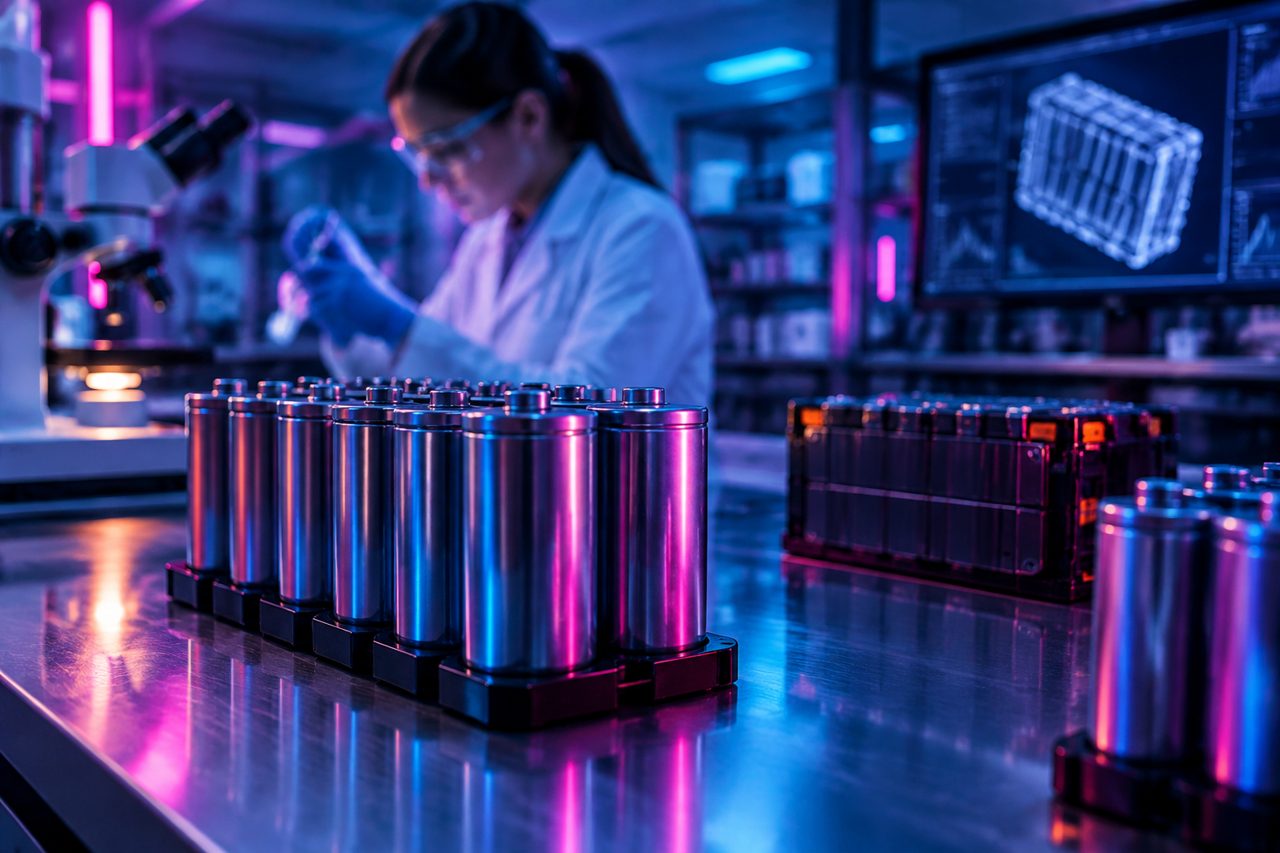
A city car driven sparingly, a power tool that recharges quickly, a building that stores its solar electricity: these three applications do not need the same battery. That is precisely where sodium-ion becomes interesting. Less dependent on lithium, this technology offers another route to electrifying transport and stabilizing power grids. But between a promising cell and a competitive product, factories still need to be brought into operation and performance needs to be confirmed. Looking ahead to September 2026, its future therefore deserves more than a slogan about a “miracle battery”.
The factual basis of this analysis rests on public announcements and developments documented through 2024. The outlook for September 2026 consists of scenarios, not a verified assessment of announced production launches.
Sodium changes the resources, not the laws of physics
A sodium-ion battery works on a principle similar to that of a lithium-ion battery: ions move between two electrodes during charging and discharging. Here, sodium replaces lithium as the charge carrier. Its appeal stems in particular from its abundance and wider geographical availability, which can reduce exposure to certain supply pressures.
Yet it is not simply a matter of filling a battery with salt. Suitable active materials, high-performance electrolytes and, generally, a hard-carbon anode must be manufactured. The quality, purity and consistency of these components matter just as much as the availability of sodium itself. An abundant resource does not guarantee a low-cost cell.
The main trade-off concerns energy density: at a comparable weight or volume, sodium-ion cells generally store less electricity than the best lithium-ion cells. Storing the same amount of energy therefore often requires a larger battery. This disadvantage becomes decisive in some vehicles; it may be acceptable in a stationary installation.
CATL: making sodium suitable for mass production
In July 2021, CATL unveiled a first generation of sodium-ion cells, announcing an energy density of up to 160 Wh/kg. The Chinese group also highlighted fast charging and good low-temperature performance. These figures were performance claims made by the manufacturer, not a guarantee of identical results in every vehicle and under all conditions.
CATL had also unveiled a battery pack concept combining sodium-ion and lithium-ion cells, called AB. The idea is revealing: rather than abruptly replacing one chemistry with another, the manufacturer envisaged combining them to balance their properties. Such an architecture nevertheless requires suitable electronic and thermal management, as well as carefully controlled industrial integration.
CATL’s advantage extends beyond the laboratory. The group has production experience and established relationships with automakers. That could make it easier to qualify a new technology. But the manufacturer’s size does not remove the need to demonstrate manufacturing yields, pack reliability and actual costs. A cell announcement alone is not proof of large-scale deployment.
Tiamat: power before the race for range
In France, Tiamat illustrates a different approach. Born out of research by the CNRS and France’s RS2E network, the company develops sodium-ion cells that prioritize power, fast charging and cycle life. In other words, it is not simply seeking to store large amounts of energy: it is also targeting applications where energy needs to be absorbed and released quickly.
In early 2024, Stellantis Ventures announced an investment in Tiamat. At the time, the company was pursuing plans for a factory in the Hauts-de-France region, initially targeting power tools and stationary storage, ahead of potential automotive applications. These announcements establish an industrial ambition; without subsequent verification, they do not establish the actual timeline or the volumes achieved.
Above all, Tiamat’s case is a reminder that “sodium-ion” refers to a family of technologies, not a uniform product. Electrode materials and cell design shape their strengths. A cell optimized to deliver high power should not be assessed in the same way as one designed to maximize a car’s range.
Three markets, three possible verdicts
Small cars: a credible contender, with conditions
For a city car, modest range may be enough if the vehicle remains affordable and easy to recharge. Sodium-ion could then find its place, especially where cold-weather operation offers a demonstrated advantage. But a heavier or bulkier battery can also force compromises on cabin space, energy consumption and payload.
Its most direct competitor is often lithium iron phosphate, or LFP, rather than the nickel-rich chemistries used in high-end vehicles. Yet LFP already benefits from mass production and continuous improvements. Sodium must therefore outperform a proven industrial solution against a specific set of requirements, not merely on the promise of cheaper raw materials.
Stationary storage: space is not the only consideration
In a solar installation or on a power grid, a few extra kilograms carry less weight in the decision than they do in a car. Sodium-ion may therefore seem well placed. But volume still comes at a price: land, containers, cabling and safety equipment can absorb some of the savings achieved on cells.
The relevant metric becomes the cost of the service delivered over the system’s lifetime: energy actually supplied, losses, availability and any eventual replacement. Safety must also be documented. A sodium-ion battery is not automatically nonflammable; its behavior depends in particular on its chemistry, electrolyte and system protection.
Power tools and intensive use: getting value from every recharge
For a professional power tool or certain types of industrial equipment, a few minutes of downtime can matter more than maximum runtime. A cell capable of fast charging and many cycles can create tangible value. But the right charger and power supply must be available, and those performance levels must be verified in real-world use.
The real test takes place in the factory
Sodium-ion can reuse some lithium-ion processes and equipment. This similarity lowers certain barriers without eliminating the qualification work. Electrode preparation, moisture control, cell formation and quality control must be adjusted. Scrap rates and production consistency will largely determine competitiveness.
Falling lithium prices can also erode the anticipated economic advantage. Conversely, diversifying supplies retains strategic value. The environmental impact, meanwhile, must be assessed across the product’s entire life: materials, manufacturing energy, longevity and recycling. Neither sodium’s abundance nor the absence of lithium is enough to settle the question.
What next? Looking ahead to September 2026, the most credible scenario is one of gradually increasing coexistence between chemistries. Assessing CATL, Tiamat and their competitors will require looking at products delivered, warranties and operating feedback rather than announcements alone. The right question will remain simple: for this specific application, does sodium deliver a better service at the full lifecycle cost?