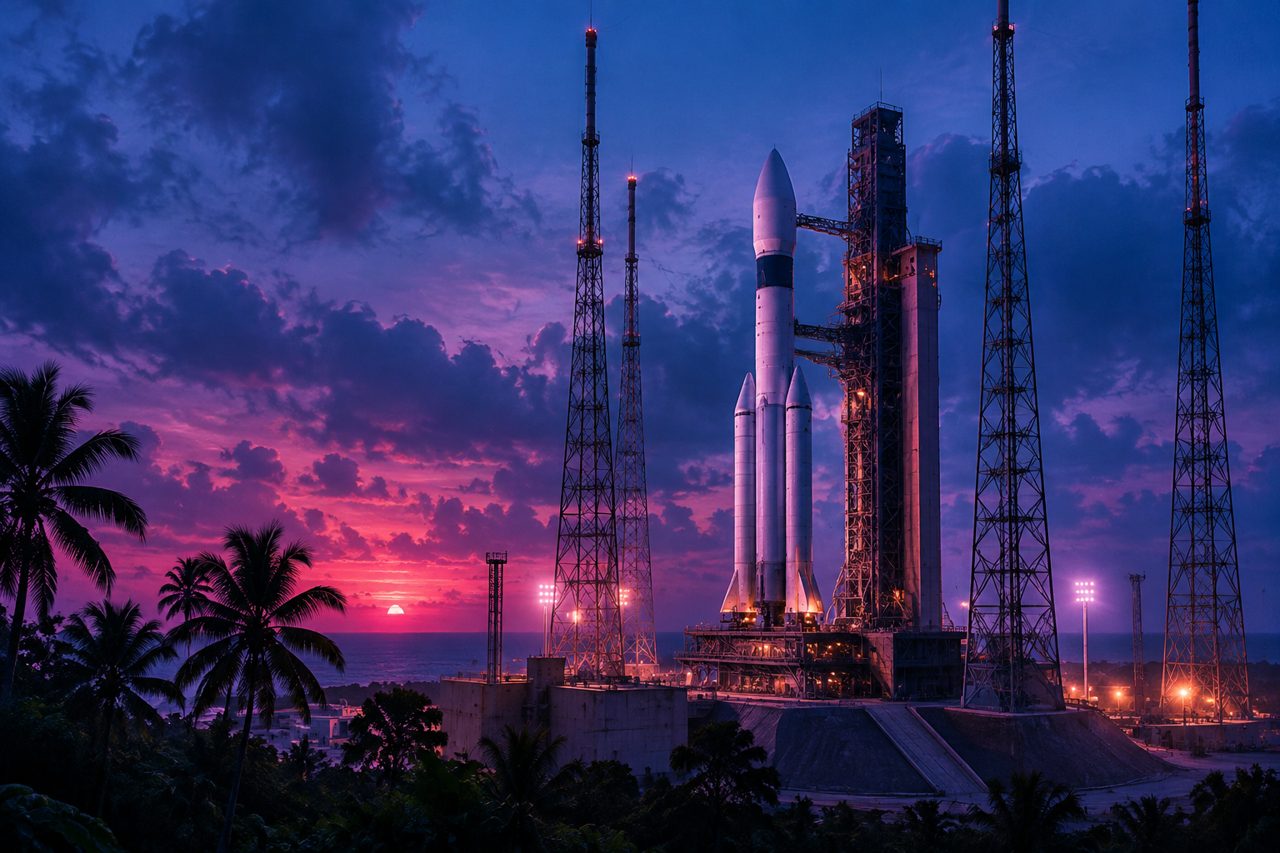
A rocket lifting off is spectacular. A rocket available when a satellite needs to launch is strategic. In September 2026, this distinction offers the clearest lens through which to view the Ariane 6 challenge: turning a technical capability into a regular service. For Europe, space autonomy depends as much on workshops, orders and schedules as on the launch pad in Kourou. Against SpaceX, the decisive battle is over launch cadence.
Reader’s note: the dated events covered here extend through Ariane 6’s first commercial flight in March 2025. Developments considered beyond that point are forward-looking analysis, not a record of achievements presented as established by September 2026.
After the return to flight, a return to availability
On July 9, 2024, Ariane 6 successfully lifted off for the first time from the Guiana Space Centre and placed its main payloads in orbit. However, an anomaly in the upper stage’s auxiliary power unit prevented completion of the planned final sequence, including the deorbit manoeuvre. The outcome was a milestone, though not flawless: Europe regained a heavy-lift launcher while taking stock of the qualification work still required.
On March 6, 2025, the first commercial flight carried the French military observation satellite CSO-3. The mission directly illustrated the programme’s purpose: enabling a strategic payload to launch without relying on a provider outside Europe. But two missions do not yet amount to a mature logistics chain. The real test is to repeat the operation, then absorb an unexpected setback without disrupting the entire schedule.
The memory of Europe’s launcher crisis continues to shape its approach. The withdrawal of Soyuz from French Guiana after Russia’s invasion of Ukraine, the retirement of Ariane 5 and the grounding of Vega-C after its December 2022 failure reduced the available options. European missions were consequently entrusted to Falcon 9, including Euclid in 2023 and Galileo satellites in 2024. Dependence was no longer theoretical.
Launch cadence starts long before Kourou
For Arianespace, which markets the launches, availability depends first on industrial prime contractor ArianeGroup and its supplier network. Engines, structures, electronics, solid propulsion: a launcher brings together complex components produced at multiple European sites. A delay affecting a single critical part can hold up an almost completed vehicle. Increasing cadence therefore means synchronising the entire chain, not merely speeding up final assembly.
The programme was designed for a rate of around ten missions a year. This industrial target must not be confused with performance already achieved. Moving towards it sustainably requires ordering long-lead-time parts early enough, securing subcontractor capacity and retaining skilled teams. A launch order often arrives too late to trigger all the necessary manufacturing on its own.
Ariane 6 nevertheless has scope for streamlining. Its Ariane 62 and Ariane 64 versions share a common architecture, with two and four boosters respectively. The P120C solid rocket motor family is also shared with Vega-C. This commonality can support production volumes and learning. It also creates interdependencies: a production incident involving a shared component can affect several programmes.
The ground infrastructure is part of the launcher
At Kourou, each campaign involves teams, facilities, tracking resources and safety operations. Ariane 6’s horizontal assembly process and the layout of its launch complex were designed to simplify workflows. But a facility’s theoretical capacity does not guarantee its actual throughput: testing, weather, maintenance and satellite availability all affect the schedule.
The right measure is therefore not simply the number of launches. It is also necessary to examine the interval between campaigns, launcher-related postponements and the spare capacity available to reschedule a mission. A system operating at full capacity may appear efficient while being unable to absorb even the slightest delay. Industrial resilience also requires reserves.
SpaceX sells more than a launch price
Against Ariane 6, Falcon 9 enjoys an advantage built on repetition. SpaceX manufactures, launches, recovers and reuses its first stages at a frequency unmatched in Europe. Its Starlink constellation generates massive internal demand, sustaining activity at factories and launch sites. This integration allows it to smooth operations and accumulate experience rapidly.
Comparing publicly listed prices is therefore not enough. For an operator, several months of waiting can delay revenue, complicate satellite financing or prolong the use of an ageing spacecraft. A credible launch slot has economic value in its own right. SpaceX competes with Arianespace on price, but also through the depth of its launch schedule and the opportunities to reallocate slots between missions.
This strength does not eliminate every vulnerability. A technical incident can halt flights and affect numerous customers. Regulatory and geopolitical constraints also remain. For Europe, having an independent option is therefore less about rejecting competition than managing risk: avoiding placing all its critical missions within a single industrial and legal system.
Orders to fill factories, not just order books
The contract announced in 2022 for 18 Ariane 6 launches for Amazon’s Kuiper constellation provides an important commercial foundation. It brings valuable visibility for the Ariane 64 version. But an order backlog is not a launch cadence: commitments must be converted into delivered vehicles, whose availability must then be coordinated with that of the satellites.
European institutional orders play a different role. Defence, navigation, observation and science can provide a relatively predictable base, provided that customer states and organisations coordinate their requirements. Without multi-year visibility, industry is reluctant to invest in equipment and recruitment that could remain underused.
The public support agreed at European level for Ariane 6 operations reflects this reality: a sovereign capability carries a cost beyond the price of each mission. That does not remove the need to demand measurable progress. Funding should support reliability, cost control and adherence to schedules, rather than turn every industrial difficulty into automatically renewed expenditure.
Autonomy is measured by the options actually available
Ariane 6 is an expendable launcher. In the short term, it cannot replicate Falcon 9’s economics of reuse. Its credible path forward starts with scaling up production of its design, stabilising operations and offering dependable commitments. In parallel, European work on reusability must prepare the next generation without diverting the expertise essential to the success of the current system.
What next? A favourable scenario does not require Ariane 6 to match SpaceX in flight numbers. It requires the launcher to provide enough reliable missions to meet Europe’s strategic needs and retain commercial customers. The question to watch after September 2026 will therefore be very concrete: can Europe offer a credible launch slot, produce the corresponding launcher and deliver on its promise? Its autonomy will be judged at this industrial level, more than by the prestige of a launch.